Replacing Salesforce and disconnected workflows with a single operations system
Insurance claim management and recovery operation
1~10 employees
Insurance operations and claim management
Claim intake, contractor submissions, document collection, review workflows, collections activity, and payment tracking
Keywords: Insurance claim management, client portals, contractor portals, document collection, review workflows, collections tracking, payment tracking
Location: United States
The company manages insurance claim workflows across contractors, service providers, documents, reviews, insurer communication, collections, and payments.
The process moves through several stages. Contractors submit invoice packages and supporting documents, internal teams validate the information, records are reviewed, communication with insurers or representatives is tracked, collections activity is managed, and payments are reconciled before closure.
The company originally approached AnyDB for customer and contractor portals. The immediate need was to simplify how external users submitted documents, reduce email-based coordination, and create a cleaner submission experience.
As the workflow was modeled in AnyDB, the team realized that much of what they were managing in Salesforce was not traditional CRM activity. It was process management around claims, invoices, documents, reviews, decisions, collections, communication, and payments.
That shifted the discussion. AnyDB was no longer only a portal layer connected to Salesforce. It became a potential system of record for insurance claim workflows.
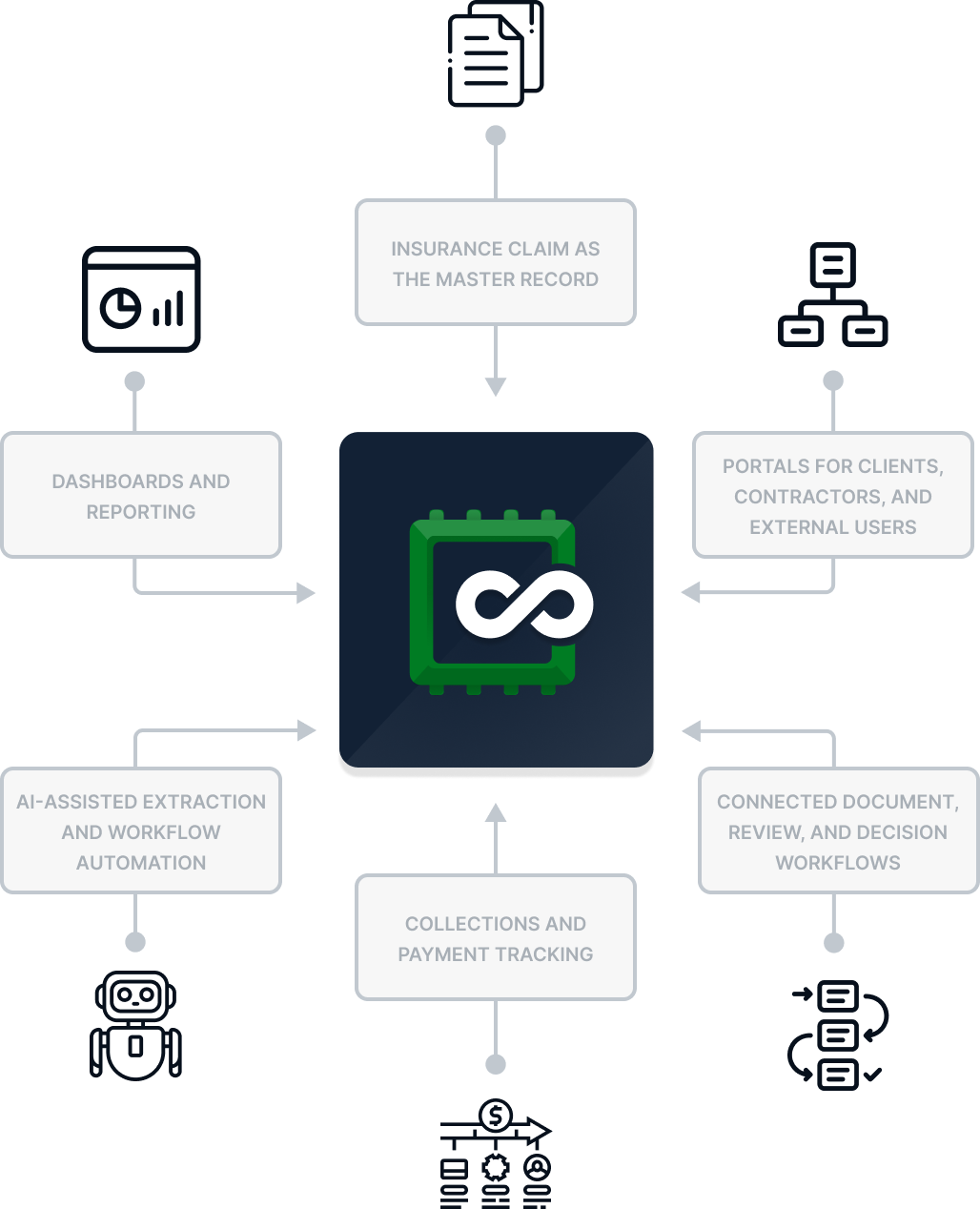
Result: A claim-centric model in which portals, intake, document collection, reviews, collections, payments, and visibility could operate from a single structured system.
In practice, that meant:
The team managed claim activity, document collection, contractor coordination, and status tracking through Salesforce, Google Drive, email communication, and shared document workflows.
Salesforce was already configured with automations and workflow logic, making it an important part of the existing operation. Google Drive was used to store documents after the team had recently moved away from Dropbox.
External users submitted invoices and supporting documents through email or shared files. Internal teams then organized documents, tracked missing items, reviewed claim information, and managed follow-ups across several tools.
This setup allowed the team to keep the process moving, although it created friction around document intake, contractor communication, missing files, and status visibility.
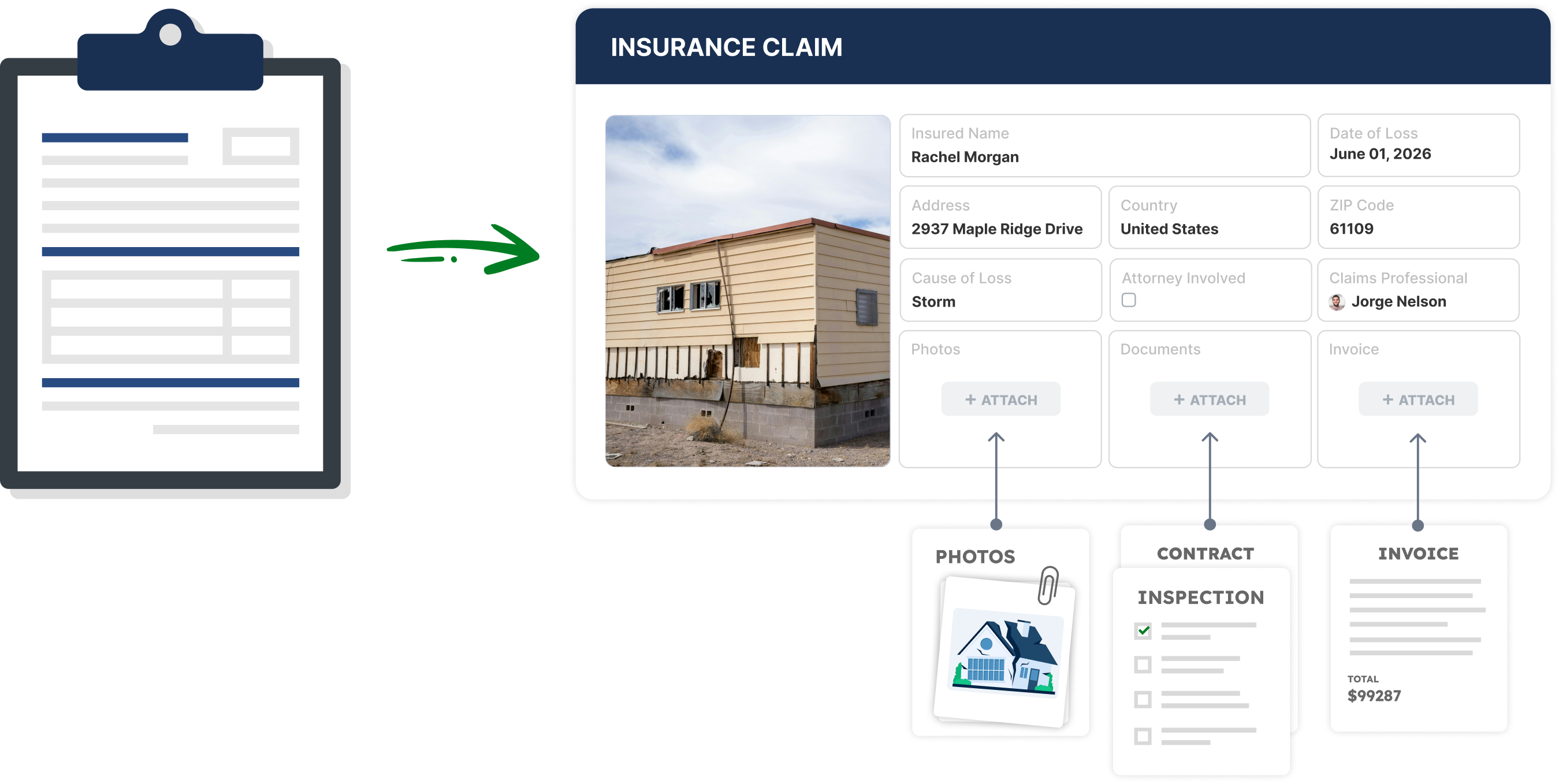
Each claim becomes the central record for the full workflow.
The record can include status, insured name, property address, insurance company, policy number, claim number, date of loss, cause of loss, service provider, claims professional, desk adjuster, coverage details, payment totals, recovery activity, and related documents.
This gives the team one place to manage the full context.
Clients, contractors, or service providers can upload invoices, service agreements, estimates, photos, policy documents, direction-to-pay forms, reports, attorney documentation, settlement documents, and other supporting files through a dedicated portal.
The portal experience stays simple for external users, with secure access to the records and fields relevant to their role.
AnyDB supports granular sharing controls, including hidden fields, locked fields, shared fields, file-level permissions, record-level permissions, and unlimited guest access.
Submitted invoices and files are connected to the claim record with details such as invoice number, service provider, invoice value, date submitted, document status, rejection reason, and review outcome.
Review workflows can follow a structured process covering claim existence, coverage verification, prior payments, property review, prior litigation, weather verification, damage validation, policy limits, pricing review, and risk level.
Decision records can capture approval status, clarification needs, adjusted value, expected recovery, and next steps.
The team can track insurer submissions, document resubmissions, representative communication, follow-up requests, collection activity, and settlement progress from the same record.
Collections workflows can include desk adjuster contact, coverage status checks, document confirmation, settlement negotiation, payment follow-up, and check tracking.
Payment records can track amount received, settlement amount, recovery percentage, expected recovery, profit or loss, and payment status.
Uploaded files can trigger workflows that extract relevant information from invoices and claim documents.
AI can use surrounding business context, including claims, contractors, documents, and related records, to support intake and review work.
Automations can create review tasks after invoice submission, notify reviewers when documents are complete, create submission activity after approval, schedule collection follow-ups, update status, calculate recovery percentages, and alert the team when activity becomes overdue.
Dashboards can show status, total submitted value, total approved value, active exposure, outstanding balance, recovery rate, settlement pipeline, aging by insurer, portfolio value, records by status, exposure by service provider, and profitability trends.

With AnyDB, daily work shifts from scattered coordination to a structured claim management process.
Reduced dependency on email-based document coordination
Simpler submission experience for clients, contractors, and service providers
Clearer structure for claims, invoices, documents, reviews, collections, and payments
Better visibility into status and review progress
More consistent handling of document reviews and follow-ups
Faster identification of missing files, overdue tasks, and stalled work
Stronger tracking of collections, recovery, and payment status
Less manual work across intake, review, routing, and follow-up
Easier workflow changes than heavily customized CRM processes
Clearer path to manage claim intake, review, collections, and payments from one system
The core workflow includes document intake, validation, review activity, insurer submissions, collections, payments, and recovery tracking. These activities require connected records, workflow logic, permissions, automations, and visibility across the full lifecycle.
AnyDB can model that structure directly. Claims become the center of the operation, with related invoices, documents, decisions, collection activity, and payments connected around them.
This makes AnyDB especially relevant for companies using Salesforce, HubSpot, or similar CRM platforms as customized operational systems. When CRM objects are heavily customized to manage internal processes, approvals, documents, and workflows, AnyDB can become a more flexible and custom system.