From Manual Inventory Checks to Real-Time, Scan-Based Pharmacy Operations

Replacing fragmented spreadsheets with a live operational system for consumables, suppliers, and staff compliance.
Free Demo / Setup
Book a demo and let us set up AnyDB for you. Free of charge!
  • Company

    Independent compounding pharmacy

  • Team

    ~25 employees

  • Industry

    Compounding pharmacy

  • Scale

    ~300 consumable inventory items

This pharmacy produces custom medications while managing a constant flow of consumables used in compounding, packaging, and shipping. Items move daily across storage areas and workstations, and availability directly affects production continuity.

In parallel, the team tracks staff licenses, certifications, and issued safety equipment, all of which require accurate records and timely renewals to stay compliant.

Missing information or delayed updates create immediate operational risk.

Result: A single system where inventory, supplier data, and staff compliance stay connected and updated in real time.

Operational Objective

Create a system that keeps inventory, staff documents, and compliance accurate during daily work, without relying on end-of-day updates or manual checks.

In practice, that meant:

  • Track ~300 consumable items (including controlled consumables) across storage locations
  • Record stock movements using barcode scans
  • Show real-time stock levels and item locations
  • Alert the team before supplies run low
  • Support purchasing decisions with accurate usage data
  • Maintain structured staff records with licenses and certifications
  • Trigger alerts before license expirations
  • Keep the system simple enough for pharmacists and technicians to use continuously

What they tried first?

The team relied on multiple spreadsheets split by category (inventory, staff, safety equipment) and maintained by different people.

To maintain these spreadsheets, staff regularly walked through storage areas to manually count consumables and safety equipment, then returned to update the spreadsheets later, adding more delay and inconsistency.

Alerts for low inventory or license expiration did not exist, history for controlled medications was difficult to track, barcode labels already existed, though they were not used for tracking movements.

Where the Operation Broke Down?

The spreadsheet setup created errors and constant manual rework as inventory and workload grew.

What broke?

  • Multiple spreadsheets with no unified view
  • End-of-day updates instead of real-time tracking
  • No use of barcode scanning for movements
  • Manual shelf checks to confirm stock
  • No automated low-stock visibility
  • Vendor and pricing information scattered or missing

Operational Impact

  • Inventory accuracy depended on manual reconciliation
  • Time lost counting stock and checking files before reorders
  • Stockouts interrupted compounding workflows
  • Purchasing decisions based on estimates instead of real data
  • Compliance tracking required manual follow-ups and reminders

The Operating Model After AnyDB

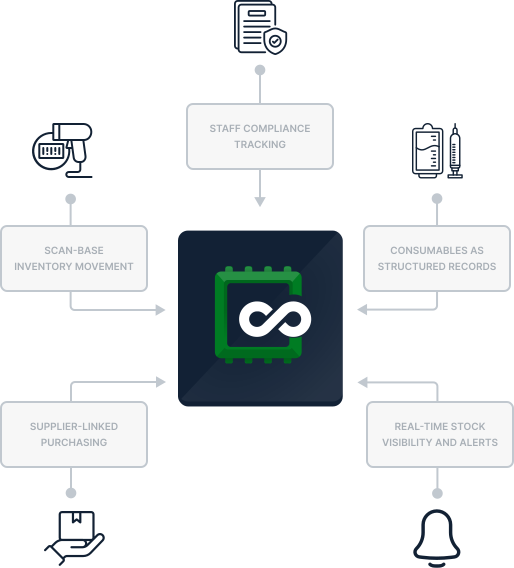
The company now has a system where inventory and compliance are recorded as part of daily work, keeping stock levels and staff records continuously updated without extra steps.

Scan-based inventory movement

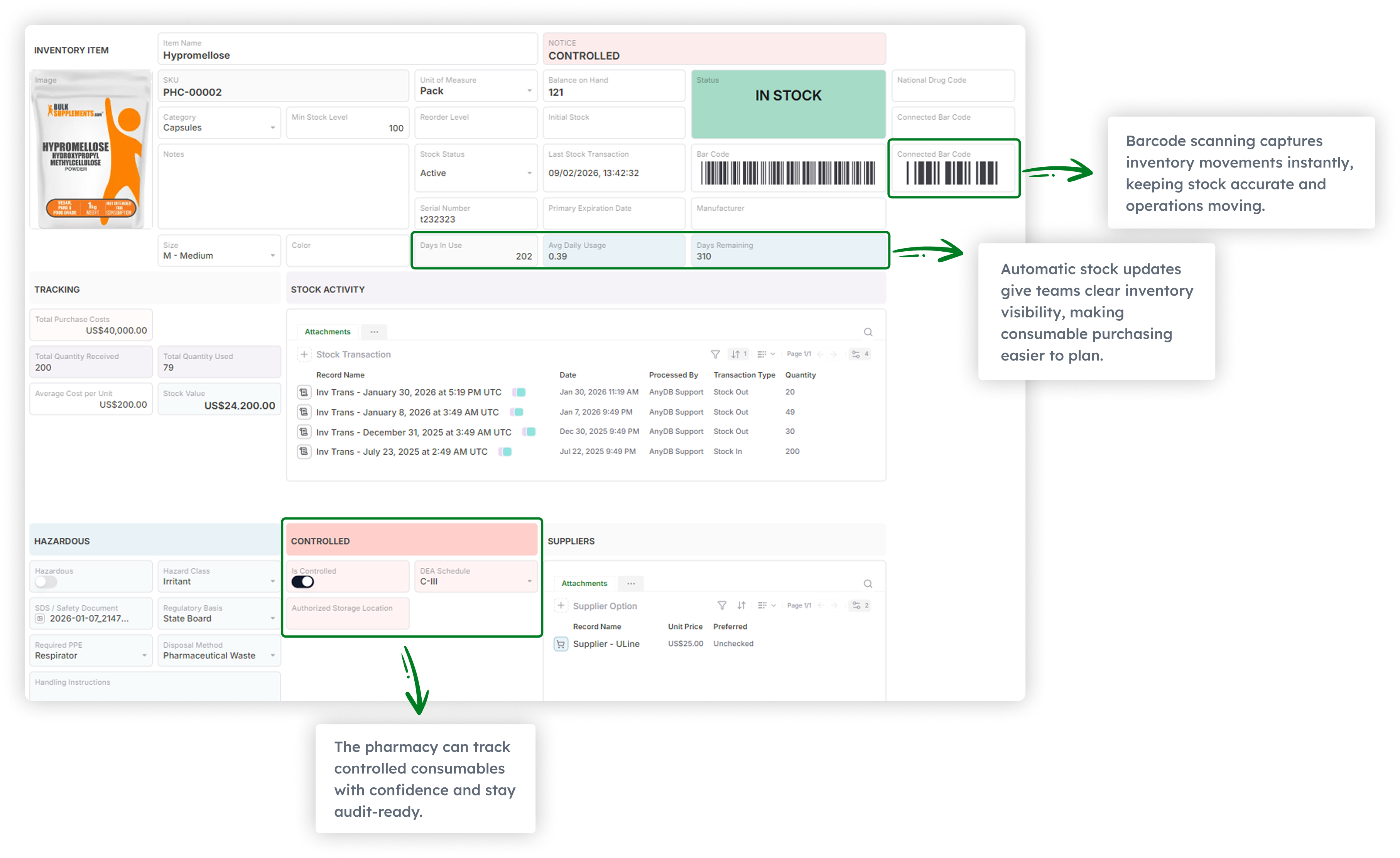
Staff scans items as they are used or restocked. Each scan records the movement instantly, so stock levels stay accurate during compounding instead of being updated later.

Consumables as structured records

Each item holds its stock level, location, supplier, and movement history in one place, allowing the team to see what is available and where it is stored without checking multiple files.

Real-time stock visibility and alerts

Low-stock thresholds trigger alerts based on actual usage, allowing the team to reorder before shortages affect production.

Supplier-linked purchasing

Inventory items connect to supplier records, so purchasing decisions use recent pricing and vendor history instead of searching through invoices.

Staff compliance tracking

Licenses, certifications, and issued equipment stay attached to each employee record, with alerts triggered automatically before expiration dates.

What Changed in Daily Work?

  • Staff scan items during compounding instead of updating spreadsheets later
  • Inventory stays accurate without end-of-day reconciliation
  • Stock checks happen on screen instead of walking shelves
  • Purchasing decisions rely on live stock and usage data
  • Compliance tracking runs through automated alerts instead of calendar reminders
  • Staff access inventory and compliance data in one place

Operational Outcomes

Inventory reconciliation time reduced from ~3 hours per week to under 30 minutes

Manual data entry for stock movements reduced by ~70%

Stockouts reduced by ~30–50% through earlier low-stock visibility

Inventory checks completed in minutes instead of manual shelf counts

License tracking moved from manual reminders to automated alerts before expiration dates

Why This Works and Scales?

This model works because updates happen during the work itself.

  • Operations: Consumables are tracked through barcode scans during daily work, removing manual reconciliation, reducing stockouts, and cutting reconciliation time. Low-stock alerts trigger automatically based on real usage.
  • Compliance: License expirations are tracked with automated alerts, and safety equipment stays linked to each employee record, making issuance and status easy to verify.
  • Pharmacists: Accurate, real-time inventory reduces interruptions caused by missing supplies, keeping compounding and production flow consistent.
  • Admin: Multiple staff members update the system in parallel without conflicts, working from the same live data. The structure adapts as processes change without requiring rework.

Everything You Need in One Platform.

No More Spreadsheets. No More Workarounds. Just Real Operational Control.