Custom Performance Review
Management System with AnyDB

Replacing fragmented performance review coordination with a connected operational system for employee self-reviews, manager feedback, HR review, final approvals, and team-level visibility.
  • Company

    Technology consulting and engineering firm

  • Team

    100+ employees

  • Industry

    Technology consulting

  • Scale

    Performance reviews managed across 20+ teams

Keywords: Performance review management, employee evaluations, HR workflows, manager reviews, team reviews, performance tracking, review coordination

Location: United States

The company is a technology consulting and engineering firm supporting the banking, financial services, and insurance sector.

Its teams work across strategy, engineering, and innovation, helping clients solve complex business and technology problems through custom digital solutions.

Managing evaluations across more than 100 employees and 20+ teams required a structured process for self-reviews, manager feedback, HR review, approvals, and team-level completion tracking.

Each evaluation needed to move through multiple stages, from employee submission to manager feedback, employee discussion, HR review, next-level approval, and completion.

Result: A connected performance review management system where employees, managers, HR, leadership, forms, ratings, statuses, and team dashboards operate from one structured environment.

Operational Objective

Create a custom performance review system capable of managing employee evaluations across multiple teams, review cycles, managers, and approval stages.

In practice, that meant:

  • Collect employee self-reviews through structured forms
  • Capture key accomplishments and areas for improvement
  • Allow managers to review employee submissions
  • Add manager feedback directly to each employee record
  • Route evaluations from manager feedback to HR review and final approval
  • Maintain employee details, department, designation, joining date, and reporting manager
  • Track manager ratings and overall feedback
  • Give HR and leadership visibility into cycle progress

What They Tried at First

The company initially used Google Forms to collect employee self-reviews.

This helped capture basic responses such as accomplishments, areas for improvement, and review comments.

As the process expanded across 100+ employees and 20+ teams, Google Forms became difficult to manage as the main review system.

Each submission needed to connect with employee records, manager feedback, HR review, approval status, ratings, team dashboards, and completion tracking.

Without that structure, coordination depended on manual follow-up, and teams had limited visibility into the status of each evaluation.

The company needed one system to manage the review cycle from employee submission through final approval.

Where the Operation Broke Down

The review process became difficult to coordinate across multiple teams, roles, and approval stages.

What broke:

  • Self-review responses were disconnected from employee records
  • Manager feedback lacked a consistent connection to each evaluation
  • HR could not easily identify reviews waiting for attention
  • Next-level approvals lacked clear ownership and status tracking
  • Rating criteria were difficult to standardize across teams
  • Team leads lacked visibility into submission progress
  • Pending and completed forms required manual monitoring
  • Managers lacked one place to review accomplishments, ratings, and feedback

Operational impact:

  • HR spent more time checking review status manually
  • Employees and managers required repeated follow-up
  • Reviews could remain stalled between stages
  • Completion progress was difficult to monitor across teams
  • Feedback and ratings were harder to compare consistently
  • Leadership had limited visibility into cycle progress

The Operating Model After AnyDB

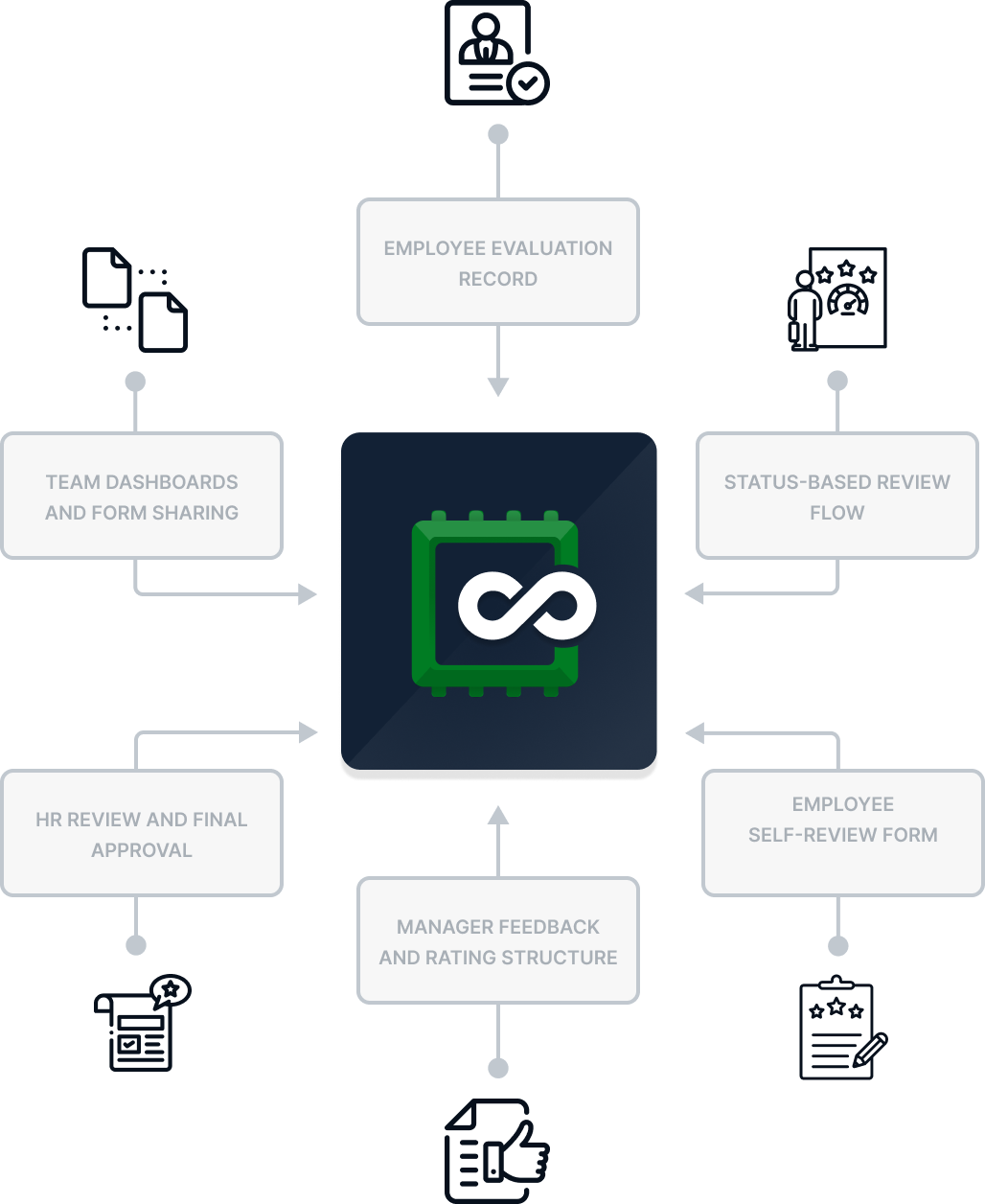
A performance review management system where each employee evaluation operates as a structured record connected to team dashboards, review cycles, manager feedback, ratings, HR review, and final approval.

Employee evaluation record

Each evaluation is managed as a structured record.

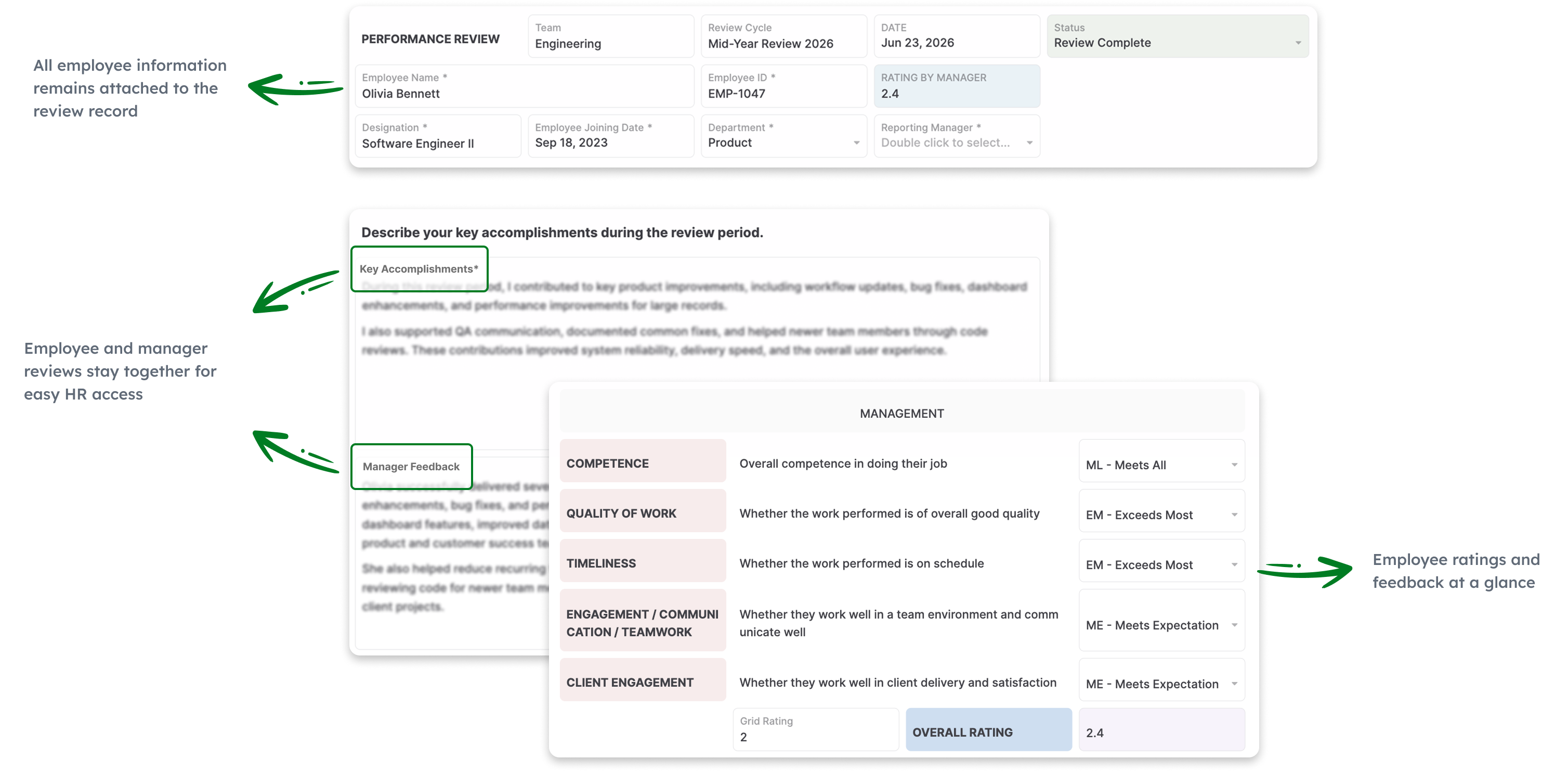
The record includes the employee name, employee ID, designation, joining date, department, reporting manager, team, review cycle, review date, status, manager rating, and feedback.

This gives HR, managers, and leadership one place to review employee details, feedback, ratings, status, and approvals.

Status-based review flow

The review cycle follows a clear progression:

  • Employee self-review
  • Manager review
  • Employee final discussion
  • HR review
  • Next-level manager approval
  • Review complete

In AnyDB, status options can include:

  • Waiting for Employee Self-Review
  • Waiting for Manager Review
  • Waiting for Employee Final Discussion
  • Waiting for HR Review
  • Waiting for Next-Level Approval
  • Review Complete

This helps each stakeholder understand what needs attention and who owns the next step.

Employee self-review form

Employees complete a structured self-review form during the cycle.

The form captures key accomplishments and areas for improvement, giving employees a consistent way to describe their work, progress, and development needs.

Each submission becomes part of the evaluation record, giving managers direct context for their feedback.

Manager feedback and rating structure

Managers review employee submissions and add feedback inside the same record.

The rating grid standardizes evaluations across key areas:

  • Competence
  • Quality of Work
  • Timeliness
  • Engagement, Communication, and Teamwork
  • Client Engagement

Each category can be rated using defined options such as:

  • MS: Meets Some
  • ML: Meets All
  • EM: Exceeds Most
  • EA: Exceeds All

The system also captures overall manager feedback, HR or executive feedback, and an overall rating.

HR review and final approval

After the employee and manager complete their discussion, the final version moves to HR for review.

The next-level manager can then approve the final outcome, keeping the approval path visible and tied to the same evaluation.

This creates a clearer handoff between managers, HR, and leadership during each cycle.

Team dashboards and form sharing

Team dashboards give managers and HR visibility into review progress across teams.

Each dashboard can show the team name, manager or lead, review cycle, date, team size, submitted reviews, completed forms, and completion percentage.

AnyDB forms allow the company to share the review template with employees and teams. Each submitted form connects back to the system, keeping responses, feedback, status updates, and completion tracking in one place.

This reduces manual coordination during review cycles and keeps each submission tied to the correct employee, manager, team, and status.

What Changed in Daily Work?

  • Employees submit self-reviews through structured forms
  • Managers review accomplishments and improvement areas from the same record
  • Manager feedback stays tied to each employee evaluation
  • Status fields show where each review stands
  • HR can see which evaluations are waiting for attention
  • Next-level approvals are easier to track
  • Rating categories remain consistent across teams
  • Team dashboards show submissions and completion progress
  • Managers can monitor activity by team
  • HR spends less time checking status manually
  • Leadership gains clearer visibility into review progress across the organization

Operational Outcomes

A more structured evaluation process across 100+ employees

Clearer coordination across employees, managers, HR, and leadership

Better visibility into status and completion progress across 20+ teams

More consistent manager feedback and rating criteria

Reduced manual follow-up and a reusable structure for future review cycles

Result: Performance reviews now run through a connected system where self-reviews, manager feedback, ratings, HR review, approvals, and team dashboards stay aligned.

Why This Works and Scales

This model works because employee evaluations involve multiple participants, stages, records, and approval points.

Each evaluation becomes the central record. Self-review responses, manager feedback, ratings, HR comments, executive input, status, and final approval stay connected throughout the cycle.

Managers get the structure they need to evaluate employees consistently. HR gains visibility into progress and completion. Leadership gets a clearer view of review activity across teams.

The system can support future cycles by reusing the same structure and adapting fields, rating criteria, forms, dashboards, and approval stages as the company’s process evolves.

This gives the company a flexible operational system for managing performance reviews at scale across teams, managers, employees, HR, and leadership.

Run Performance Reviews From One Connected System.

Build your custom performance review management system with AnyDB, or let us build it for you.