
Published on October 25, 2026


A customer places a large order for customized products. Sales confirms the delivery date, and the warehouse starts preparing the shipment. Everything looks on track until a supplier delay forces the team to ship part of the order later. The invoice, however, still lists the full quantity. When the customer questions the charge, finance must trace the shipment, verify the order details, and figure out where the records stopped matching.
The order to cash (O2C) process connects the customer’s original order to fulfillment, invoicing, and the final payment reconciliation. Each stage borrows its facts from the one before, so a small gap can travel a long way.
A sale is not finished when the order is confirmed or the truck leaves. It is finished when the right amount is matched to the right invoice.
In this article, we’ll examine order to cash key stages, where they tend to break down, and how connected operational systems and AI can help teams spot issues before they become bigger problems.
Where the Order to Cash Process Breaks Down
An order can pass through five departments and still carry the same mistake from the first email to the final invoice. As order volumes grow, product specifications multiply, and suppliers or delivery partners join the process, keeping every detail aligned becomes harder. People may do their jobs correctly while working from records that tell different versions of the same story.
Most breaks happen at a handoff. Sales passes the order to credit, credit to the warehouse, and the warehouse to finance, and each handoff is a chance for a detail to stay behind. A missing specification, an approval buried in an inbox, a shipment quantity that never reached the billing record, or a payment that arrives without an invoice number. The invoice is where the costs of earlier shortcuts finally come due.
These gaps have consequences beyond extra admin. Delayed invoices and disputed charges can postpone collection, make cash forecasts less reliable, and strain customer relationships. Managers may see overdue balances without knowing whether the cause is a collection issue, a delivery discrepancy, or an approval that never moved forward.
The trust cost is real too: IBM cites a 2024 BlackLine survey in which nearly 40% of CFOs said they do not completely trust their organization’s financial data, and it ties that doubt to manual processes and weak visibility.

The Order to Cash Process Step by Step
The order to cash process follows a transaction from the moment a customer places an order to the point when payment is received and recorded. The exact workflow depends on the business. A service provider may bill after completing a project milestone, while a manufacturer might need to coordinate many stages before issuing an invoice.
1. Order Intake and Validation
Every transaction starts with a commitment. An order might arrive through a sales representative, email, an ecommerce platform, or a customer portal. The team records the customer’s details, products or services, quantities, agreed prices, delivery requirements, and payment terms, then checks that the information is complete and consistent.
This record becomes the reference for the work ahead. If a customer requests a specific configuration or negotiates a discount, those details need to follow the order into fulfillment and invoicing. In our customized batch, that means the special specifications and the agreed price live on the order itself, where every later stage can find them.
2. Credit Management and Order Approval
For transactions involving payment after delivery, the business may need to review the customer’s credit limit, outstanding balance, payment history, and agreed terms before releasing the order. Internal approvals may also apply to special pricing or exceptions to standard conditions.
For instance, a large order from a customer on payment terms may need a credit review before the warehouse starts picking. That review needs an owner, a visible status, and a clear next step, so sales and fulfillment are never left guessing when work can begin.
3. Order Fulfillment and Delivery
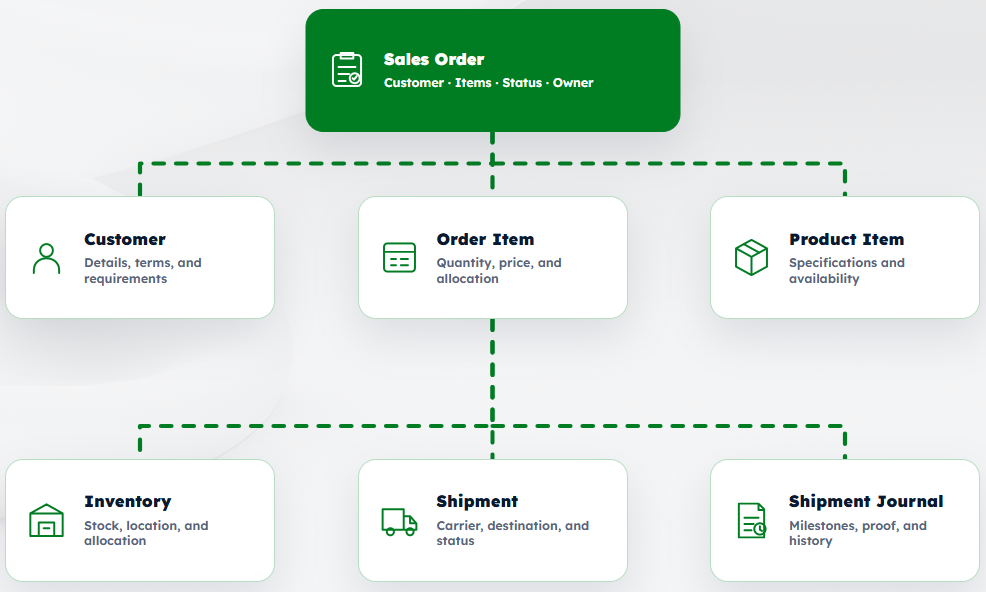
With the checks complete, the business delivers the goods or the service. For physical orders, that can mean allocating stock, ordering from suppliers, picking, packing, and shipping. Service teams coordinate people and milestones instead.
Back in our customized batch, when the supplier delay splits the shipment in two, the system should show what left, what is still waiting, and the new expected date. Those facts decide what finance can bill and when.
For a closer look at this stage, see AnyDB’s guide to order fulfillment.
4. Invoicing and Accounts Receivable
Once a billing milestone is reached, the business invoices based on the agreed terms and the fulfillment records, and accounts receivable tracks the amount owed and its due date. Depending on the contract, the trigger might be shipment, delivery confirmation, or a completed milestone.
An invoice for the full quantity after a partial shipment is the kind of mismatch that prompts a customer to call and your payment to the back of the queue.
5. Payment Collection and Cash Application
As invoices approach their due dates, the business monitors outstanding balances, follows up on overdue payments, and resolves questions that may prevent collection. Once money arrives, another task remains: cash application, the process of matching that payment to the correct customer account and invoice.
The match may be straightforward, or it may need investigation when a customer pays several invoices together, sends a partial amount, or omits the invoice reference. If our customer pays only for the shipped part, that payment will not match the full-quantity invoice until someone corrects it. After the payment is reconciled, financial records can be updated to reflect the remaining balance or close the transaction.
A payment with no invoice reference is a gift with no name tag. Someone has to work out who sent it.
How AnyDB Connects Order to Cash Operations
An order can involve sales, purchasing, warehouse staff, suppliers, and finance, each with a different part of the picture. AnyDB gives businesses a way to connect those records and responsibilities through a custom operational system built around how their operations actually work.
Here is how that connected approach can support common order to cash challenges:
| O2C challenge | Disconnected approach | How AnyDB can help |
| Inventory or delivery status changes | Sales and finance may keep working with outdated information. | Link orders with inventory, supplier, shipment, and delivery records. |
| An invoice needs clarification | Employees search separately for approvals, delivery details, and supporting documents. | Keep relevant operational records and documentation connected. |
| A transaction is waiting for action | Approvals and follow-ups get buried in messages. | Use assigned tasks, configurable workflows, reminders, and views to surface pending work. |
This approach can complement the systems a company already uses for accounting, enterprise resource planning, or payment processing. AnyDB focuses on the operational connections that help people understand what happened, what needs attention, and who should take the next step.
Bring AI Into the Process
Connected information also gives AI a more useful place to work. AnyDB’s AI Teammates can be configured with a specific role, goal, instructions, skills, and access to relevant business records. Within those boundaries, they can investigate operational issues, identify exceptions, and prepare follow-ups for review.
Picture our customized batch two days before its promised delivery date, with a linked supplier record showing a delay. An authorized AI Teammate reviews the purchase order, inventory status, expected dates, and activity history, flags the risk, and prepares a supplier follow-up for the purchasing owner to approve. The team can adjust the delivery plan and the invoice before the customer ever has to ask.
Nothing goes out, and no committed delivery date changes, until a person approves it.
AI will not fix a process nobody has mapped, and it does not replace credit rules or financial controls. It works best on records that are already connected.
Keep Every Order Moving Through to Payment
A sale ends when payment is matched, so every handoff before that moment deserves a second look. For each handoff in your own process, write down three things: the record it creates, the record it has to match, and the person who owns the gap between them.
Pro Tip: Pull ten recent orders and compare the shipment date with the invoice date. The orders where those dates drift apart will show you where you’re losing time, accuracy, and visibility.
Start with a free AnyDB plan today and build a connected operational system that helps your team manage orders, track fulfillment, and keep every transaction moving toward payment.
Frequently Asked Questions About Order to Cash
The answers below cover the fundamentals of the order to cash process, from its core stages to practical ways to improve operations with automation and AI.
1. What does “order to cash” mean?
Order to cash (O2C) is the end-to-end process that takes a customer order through validation, credit checks, fulfillment, invoicing, payment collection, and reconciliation. It connects operational and financial activities until the transaction is completed. The exact stages depend on the company’s industry and business model.
2. What are the main steps in the order to cash process?
The five core stages are order intake and validation, credit management and approval, fulfillment and delivery, invoicing and accounts receivable, and payment collection and cash application. Some companies separate activities such as shipping, collections, and financial reporting into extra steps.
3. What is the difference between order to cash and quote to cash?
Quote to cash (Q2C) covers a broader commercial lifecycle, starting with pricing, quotes, negotiations, and contracts. Order to cash typically begins when a customer places an order and follows its execution through payment reconciliation. O2C is one part of the wider Q2C process.
4. How can a business improve its order to cash process?
Map the full process, assign clear ownership, reduce duplicate data entry, and connect order and fulfillment records to invoices. Track invoice disputes, days sales outstanding (DSO), perfect order rate (the share of orders delivered on time, undamaged, and without other issues), and order-to-payment time to identify bottlenecks. Automation works best when it addresses a specific operational gap.
5. How can AI help with order to cash?
AI can review connected records, flag delayed orders or discrepancies, summarize exceptions, and prepare follow-ups for employees to review. Reliable data, defined access permissions, and human oversight are essential, especially when an action affects credit decisions, customer commitments, or financial records.

The End-to-End Operations System that Finally Fits Your Reality.
No more scattered spreadsheets or rigid, disconnected tools.
AnyDB is a modern, customizable platform for managing business records and operations across teams, clients, and partners.
Learn More


Phone: (512)-761-7979
© 2024 Humanly Inc. All rights reserved.
What is AnyDB?
AnyDB is a unified, customizable data store designed to streamline and empower your entire organization. Effortlessly store, organize, and share custom business data to drive both internal and external operations across teams. Think of it as spreadsheets on steroids.Perfect for Sales, Marketing, Operations, HR, and beyond. Discover AnyDB