
Published on May 31, 2026


For many Shopify businesses, Stocky was the default answer to inventory management.
It helped teams manage purchasing, supplier relationships, inventory counts, stock transfers, and demand forecasting without leaving the Shopify ecosystem.
With Stocky Shopify now being discontinued, many companies are reassessing how they manage inventory and operations moving forward.
Questions around stock visibility, purchasing workflows, supplier coordination, and inventory traceability come to the surface.
Often, replacing Stocky is less about finding similar features and more about building a stronger operational foundation.
The best Stocky Shopify alternative is not necessarily the platform with the longest feature list.
In this article, you’ll learn:
- What happened to Stocky and why businesses are looking for alternatives
- Which capabilities matter most when evaluating inventory software in 2026
- The best Stocky Shopify alternatives available today
- How AnyDB helps organizations manage inventory through connected object-based operational workflows.
What Happened to Stocky and Why Businesses Are Exploring Alternatives
For years, Stocky Shopify was a popular choice for businesses looking to manage inventory inside the Shopify ecosystem.
Shopify has announced that Stocky is being discontinued on August 31, 2026, and the app was already delisted from the Shopify App Store on February 2, 2026.
Furthermore, critical capabilities like direct inventory transfers between locations and min/max stock levels for forecasting are being deprecated.
For merchants who rely on these tools daily, the deadline to find a robust alternative is fast approaching.
Stocky used to connect to suppliers, purchasing workflows, fulfillment teams, stock transfers, and reporting.
Once businesses begin planning a migration away from Stocky, these connections become much more visible.
This is often the moment when teams discover that inventory processes are more interconnected than they first appeared.
As a result, the way businesses check inventory software in 2026 is changing.
Many organizations are now looking for:
- Greater operational visibility.
- Stronger traceability and audit history.
- Better supplier collaboration.
- Connected purchasing workflows.
- Multi-location inventory management.
- Flexibility as operations evolve.
The search for a Stocky Shopify alternative is often less about replacing a familiar tool and more about finding a platform that can support the next stage of operational growth.

Best Stocky Shopify Alternatives for Growing Businesses
The right Stocky Shopify alternative depends less on feature count and more on operational fit.
Some businesses need better inventory forecasting. Others need stronger purchasing controls, supplier collaboration, warehouse visibility, or traceability across the entire inventory lifecycle.
The question is not “Which platform has the most features?”. It is “Which platform supports the way your business actually operates?”
| Platform | Best For | Strengths | Considerations |
| Shopify Inventory | Smaller Shopify stores. | Native experience, easy setup. | Limited operational workflows. |
| Sumtracker | Growing e-commerce brands. | Inventory sync and forecasting. | Less operational flexibility. |
| SKUSavvy | Warehouse-focused operations. | Inventory visibility and warehouse management. | More focused on inventory than broader operations. |
| Cin7 | Multi-channel inventory businesses. | Strong purchasing and inventory capabilities. | Higher complexity and cost. |
| Katana | Manufacturers and product businesses. | Production and inventory planning. | Manufacturing-focused. |
| NetSuite | Enterprise operations. | ERP level inventory and financial management. | Significant implementation effort. |
| AnyDB | Businesses with custom operational processes. | Object-based records, flexible workflows, supplier collaboration, and traceability. | Requires process design around operational needs. |
What Should You Look for in a Stocky Alternative?
As businesses evaluate alternatives, a few capabilities rise to the top.
Real-Time Inventory Visibility: Inventory should remain visible across warehouses, locations, suppliers, and operational workflows. When teams rely on multiple reports to understand stock levels, decisions slow down and confidence drops.
Supplier and Purchasing Management: Inventory is connected to purchasing activity. The best platforms help teams manage suppliers, purchase orders, replenishment planning, and stock availability within a connected process.
Multi-Location Inventory Management: As operations expand, inventory never stays in one place. Tracking movement, ownership, and availability across locations becomes essential for maintaining accuracy.
Traceability and Audit History: Inventory changes should tell a story. Teams need to know who made a change, when it happened, and why. This visibility supports accountability and makes investigations much faster when questions arise.
Flexibility: One theme appears across Reddit discussions and industry forums: businesses are often looking for more than a Stocky replacement. They want a system that can adapt as their processes evolve.
Because eventually, every growing business reaches the same realization: inventory management is connected to purchasing, suppliers, warehouses, fulfillment, and operations.
The software should reflect those relationships rather than forcing teams to manage them separately.
Why AnyDB Takes a Different Approach to Inventory Management
Many inventory platforms focus on stock counts. AnyDB focuses on the operation behind those stock counts.
It approaches inventory differently through object-based records that connect it to the broader operational workflow.
Inventory as Object-Based Records
In AnyDB, each item becomes a complete operational record rather than a row in a spreadsheet or a disconnected database entry.
An inventory record can include:
- Inventory quantities
- Warehouse locations
- Supplier relationships
- Purchase history
- Barcode information
- Attachments and documents
- Operational notes
- Activity history
This gives teams a complete view of the inventory item and everything connected to it.
As AnyDB supports barcode and QR code scanning through its mobile apps, warehouse teams can scan an item to log stock movements, stock-ins, or stock-outs in real time, eliminating the manual entry errors common in older systems.
Purchasing, Suppliers, and Inventory Connected Together
Inventory decisions rarely happen in isolation. Inventory records can connect to:
- Suppliers
- Purchase orders
- Shipments
- Warehouses
- Audits
- Replenishment activities
As a result, teams work from a single operational source of truth instead of moving between many tools and spreadsheets.
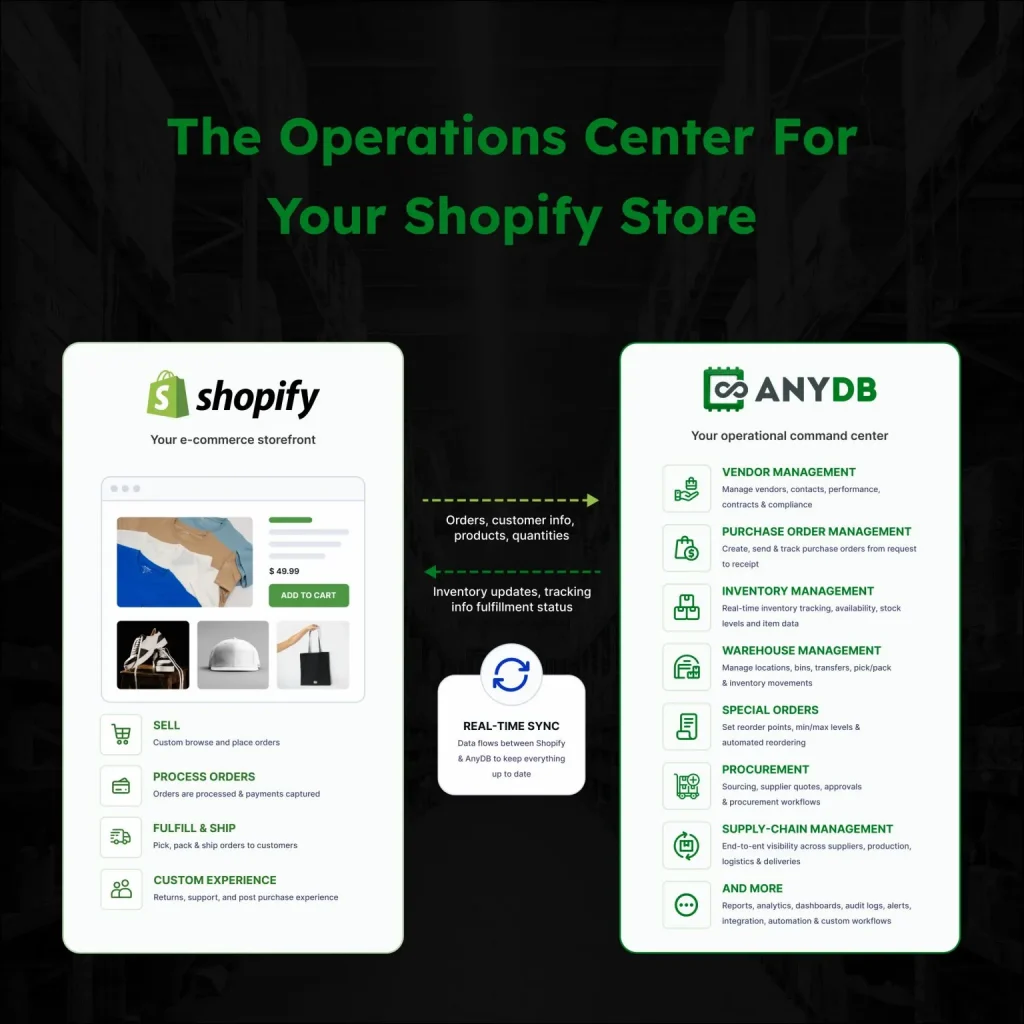
Seamless Shopify Sync
Unlike generic databases, AnyDB connects directly to your storefront through the native AnyDB Sync app. It provides configurable, bi-directional syncing of products, orders, customers, and locations.
With real-time updates via webhooks, your operational backend and your Shopify store are never out of sync.
Secure Collaboration Without Spreadsheet Chaos
Inventory management often involves external participants such as suppliers, logistics partners, warehouse operators, and auditors.
AnyDB provides secure portals and role-based permissions so collaborators can access the information they need while sensitive operational data remains protected.
Operational Visibility Across the Entire Workflow
Because records are connected, managers can track:
- Inventory availability
- Stock movements
- Supplier performance
- Open purchase orders
- Replenishment needs
- Operational bottlenecks
All from real-time operational data rather than manually assembled reports.
You May Also Like: Connect AnyDB and Shopify Integrations
Choose an Inventory System Built for Operational Growth
The most effective platforms help teams do more than track stock. They help connect the processes, people, and decisions that keep inventory moving.
When evaluating alternatives, consider how well the platform supports collaboration, traceability, operational visibility, and flexibility as your processes evolve.
AnyDB helps businesses manage inventory in a way that reflects how work actually gets done.
Ready to move beyond Stocky?
To ensure a fast and smooth transition away from Stocky, AnyDB provides a completely guided, free 2-week setup.
Our team will map out and build your custom inventory workflows for you, so you can go live without the heavy lifting.
Plus, you can try the AnyDB Sync app with a 14-day free trial to see your Shopify data map directly into your new operational system.
Schedule a call with the AnyDB team today to connect your inventory management and order fulfillment with confidence.

The End-to-End Operations System that Finally Fits Your Reality.
No more scattered spreadsheets or rigid, disconnected tools.
AnyDB is a modern, customizable platform for managing business records and operations across teams, clients, and partners.
Learn More


Phone: (512)-761-7979
© 2024 Humanly Inc. All rights reserved.
What is AnyDB?
AnyDB is a unified, customizable data store designed to streamline and empower your entire organization. Effortlessly store, organize, and share custom business data to drive both internal and external operations across teams. Think of it as spreadsheets on steroids.Perfect for Sales, Marketing, Operations, HR, and beyond. Discover AnyDB