
Published on February 28, 2026


Many small businesses still manage stock in spreadsheets, and at first, this approach feels familiar and manageable. Inventory levels live in one file, supplier details in another, and stock movements are often updated later, if they are updated at all.
Teams rely on memory, quick messages, and manual checks to keep operations moving, and for a while, it works. Until it fails.
As the business grows, cracks start to appear. Stock runs out. Duplicate orders slip through. No one is sure which numbers are current.
At this stage, a stock management system for small businesses plays a pivotal role. Not a heavy ERP. Not another disconnected tool.
Instead, it is a structured system that consolidates inventory, suppliers, movements, thresholds, and approvals into a single source of information.
In this guide, we explain:
- what stock management means for small businesses
- why spreadsheets fall short as operations grow
- which features actually matter
- and how AnyDB helps teams gain control without adding complexity or unnecessary cost.
Why Stock Management Breaks Down in Small Businesses
Stock management feels chaotic usually because of systemic issues, not team carelessness or lack of motivation.
More often, the issue lies within the underlying system that lacks a structure designed for collaboration and growth.
Spreadsheets were never designed to handle real-time updates, approvals, or traceability. As soon as more than one person touches the data, errors multiply.
No one knows who made the latest update, and there is no clear audit trail.
When stock information is unclear, teams lose momentum. Everyone feels the friction.
This is why stock management is all about coordination between teams, accountability, and trust in the data that drives daily decisions.
Key Functions of a Stock Management System for Small Businesses
A stock management system does not need to do everything. It needs to do the right things consistently, without getting in the way.
At least, the system should cover a few essential capabilities that support daily work instead of complicating it:
- The system should provide centralized inventory records, consolidating items, quantities, locations, and status into a single, up-to-date location.
- The system should provide visibility into suppliers and purchases, enabling teams to understand who supplies what, at what cost, and under what conditions.
- Stock movement tracking for inbound deliveries, outbound usage, transfers, and adjustments, all recorded as individual events.
- The system incorporates thresholds and alerts to warn teams before stock runs out and planning becomes chaotic.
- Role-based access provides managers with clarity and simplifies day-to-day views while keeping them simple for buyers, warehouse staff, and field teams.
- Audit trails, so every change can be traced, reviewed, and understood.
- The reporting system operates without the need for manual cleanup, providing a quick overview of inventory status, usage patterns, and exceptions.
When these basics are in place, inventory stops feeling like a guessing game. Conversations get shorter. Decisions get clearer.
This stage is also where many tools fall short. Traditional ERPs frequently introduce cumbersome setup and unutilized modules. Lightweight tools feel easy at first but lack the structure needed as complexity grows.
The ideal balance sits in the middle.
A stock management system for small businesses should bring structure without slowing teams down.
AnyDB Provides a Structured Approach to Stock Management
AnyDB approaches stock management by modeling inventory the way it exists in real operations, not the way rigid systems expect it to behave.
Inventory is stored as structured records, with items, quantities, locations, and status connected through relational data.
Each inventory item in AnyDB is an object-based record, not just a quantity in a table.
In day-to-day operations, that item links directly to purchase orders, storage locations, and every stock movement. When units are received, transferred, or consumed, the history stays attached to the item itself.
Nothing is overwritten. Nothing disappears.
Getting started does not require a full rebuild or a long configuration phase. Work happens directly with AnyDB to shape the system around real inventory workflows. We help map out how items move, who owns each step, and what needs to be tracked day-to-day.
From there, the structure, relationships, and views are co-created, so inventory data reflects how operations actually run, not how a generic system expects them to.
What was once a static file becomes a live system, without forcing change overnight.
External collaboration is handled through controlled portals. Suppliers or partners interact with specific data without full system access, keeping information secure.
No duplicate files. No guessing.
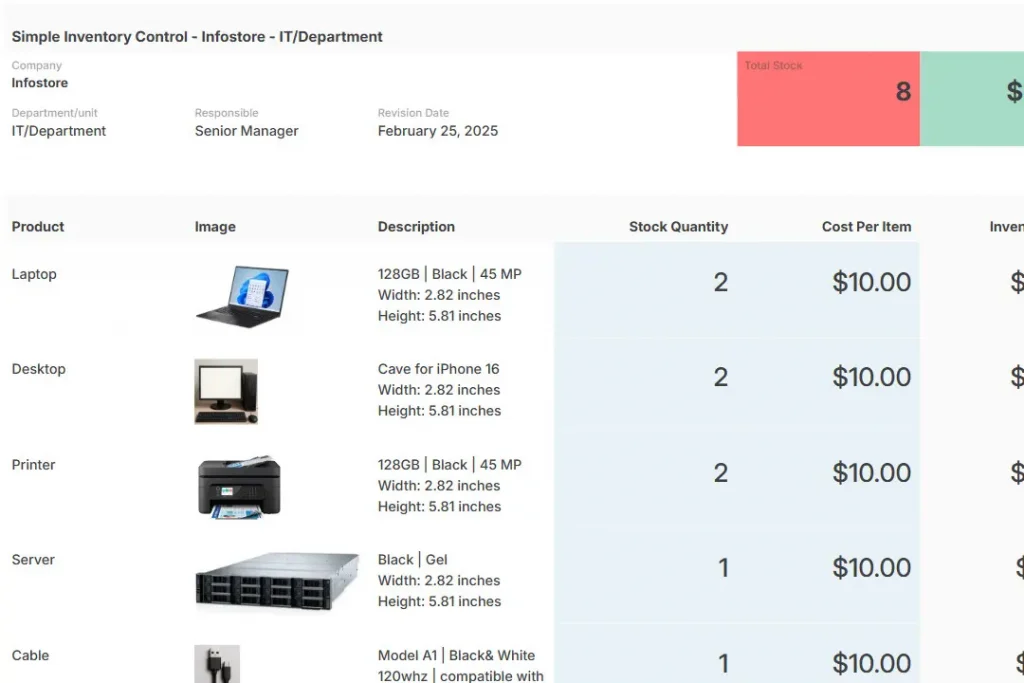
Start with ready-made stock management templates, then adapt them as workflows evolve:
Visibility, Cost Control, and Continuous Improvement
Stock management improves over time when visibility is consistent. When data stays accurate and accessible, patterns emerge and decisions become easier.
Teams begin tracking meaningful metrics such as:
- stock turnover
- out-of-stock incidents
- emergency purchases
- supplier lead times
- and inventory accuracy.
These signals reveal where processes work and where they don’t.
AnyDB supports this improvement cycle with dashboards that reflect live data and record history that enables reviews.The result is predictability. When stock data is reliable, decisions feel calm instead of reactive, and planning replaces firefighting.
Build Inventory Control That Grows With You
A stock management system for small businesses is all about stability, visibility, and confidence.
Inventory touches every part of operations, from suppliers to warehouse teams to finance and field staff. When the data behind it is clear, everyone stays aligned and work moves forward.
The best way to start is small, but you do not have to start alone.
Most small businesses begin by bringing their current inventory reality to the table. With AnyDB, inventory control is shaped together around how the business already operates.
You can sign up for a free AnyDB workspace, explore what is possible, and connect with our team to build a stock management system that actually fits how your business runs.
Frequently Asked Questions About Stock Management Systems
Below are answers to common questions small businesses ask when moving beyond spreadsheets.
Would it be beneficial for small businesses to use a stock management system?
Yes. Once more than one person updates inventory, spreadsheets stop being reliable. A stock management system for small businesses creates a single source of truth and reduces costly errors.
Can you track stock movements without manual updates?
Yes. Each inbound, outbound, or transfer is recorded as a structured event, so quantities stay accurate and traceable.
What prompts teams to transition away from using spreadsheets for stock control?
Spreadsheets fail to provide access control, history, and real-time updates. This leads to duplication, mistakes, and “Who changed this?” moments.
Can AnyDB replace spreadsheets without slowing teams down?
Yes. AnyDB keeps a familiar spreadsheet style while adding structure, permissions, and automation, making it easier to scale without chaos.

The End-to-End Operations System that Finally Fits Your Reality.
No more scattered spreadsheets or rigid, disconnected tools.
AnyDB is a modern, customizable platform for managing business records and operations across teams, clients, and partners.
Learn More


Phone: (512)-761-7979
© 2024 Humanly Inc. All rights reserved.
What is AnyDB?
AnyDB is a unified, customizable data store designed to streamline and empower your entire organization. Effortlessly store, organize, and share custom business data to drive both internal and external operations across teams. Think of it as spreadsheets on steroids.Perfect for Sales, Marketing, Operations, HR, and beyond. Discover AnyDB