
Published on March 13, 2026


Many businesses adopt ERPs with high hopes. They expect clarity, efficiency, and control. Instead, they often end up navigating:
- Rigid modules
- Slow rollouts
- Development bottlenecks
- Unexpected bills
- Teams reverting to spreadsheets when daily work becomes too painful.
Have you ever watched this happen inside your operation?
This is especially true for companies that handle custom products or services. Their operations do not follow a standard ERP template. They stretch across client onboarding, fieldwork, external collaboration, and countless specific steps that ERPs struggle to model without heavy customization.
At this point, many teams look to Odoo as the answer. It offers breadth, stability, and a familiar ERP logic.
Yet the same structure that keeps everything organized can sometimes introduce friction. Teams may find themselves paying for features they rarely use and relying on consultants for even small adjustments, especially when their operations do not fit into predefined modules.
In this article, you will learn how Odoo performs in real-world use and why businesses are switching to AnyDB for a more adaptable and cost-efficient approach.
The Hidden Cost of ERP Rigidity
Most traditional ERPs were designed for large enterprises that follow linear processes. Their strength is discipline. Their weakness is everything that falls outside that template.
Odoo’s interconnected modules look advantageous at first, but small workflow adjustments can send ripples through the entire system.
Real operations are not that orderly. They grow, shift, and adapt to clients, projects, and people. When your team cannot change a workflow without calling an internal developer or Odoo consultant, the system stops being a system.
People go back to spreadsheets. They send updates by email.
These are the moments when operational chaos sneaks in and everyone wonders why the ERP was supposed to make life easier in the first place.
Here’s the human side of the story. A manager in the field should be able to adjust a job tracking workflow without submitting a ticket. Teams should not need a consultant to keep daily work moving. They deserve a system that evolves with them, not against them.
This is the point where flexibility becomes more than a nice idea. It becomes a rule for healthy operations.
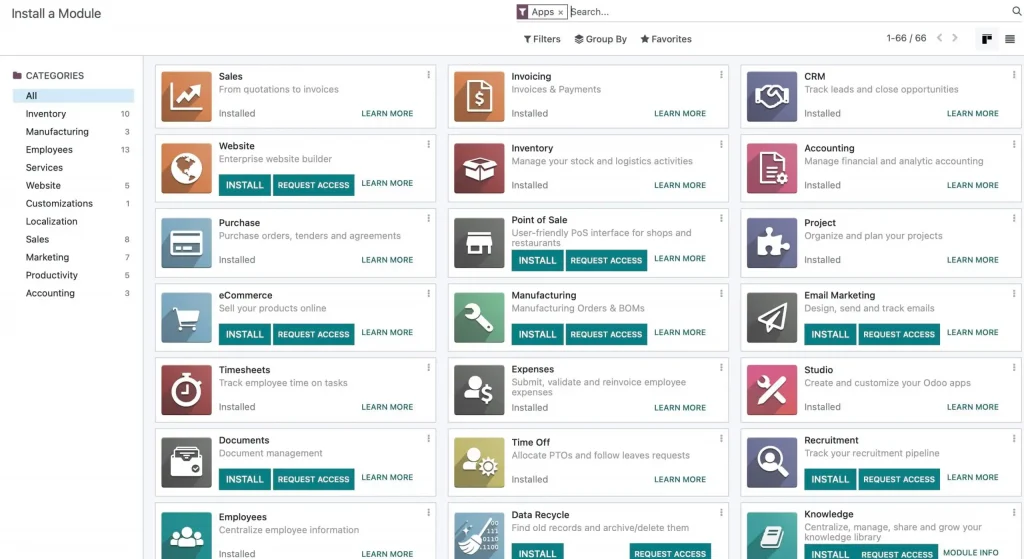
AnyDB vs Odoo: When ERP Pricing Outgrows Your Real Needs
Many teams choose famous ERPs believing the all-in model will simplify everything. Everything in one place sounds efficient until you realize the package includes tools your team never touches.
A company that only needs clients management or job progress ends up paying for entire modules that sit unused. System waste grows quietly in the background.
These moments are familiar to many leaders:
- Tools that were meant to streamline work become a source of tensions.
- Teams avoid the platform.
- Adoption drops. Shadow systems return.
Everyone knows the feeling: yet another product that does not match how the business actually operates.
AnyDB offers a different approach.
Pricing is transparent. Teams can start small and expand only when they feel ready. You use the modules that solve real problems and ignore the ones that do not. No mandatory bundles. No unexpected surprises. Just clarity.
The choice becomes much clearer. One platform that adapts to your entire operation.
From logistics to legal, from vendor management to HR reviews, real businesses need real flexibility.
| Department | Example Use Cases |
| Supply Chain | Vendor Records, Shipments, Purchase Orders |
| Inventory | Stock Levels, SKU Tracking, Warehouse Data |
| Compliance | Policy Management, Audit Logs, Checklists |
| HR | Employee Records, Onboarding, Reviews |
| Sales | CRM, Quotes, Deals, Customer Files |
Flexibility Without Developers: How AnyDB Fits Real Workflows
Teams want something simple. They want the control they are used to in spreadsheets and the reliability they expect from a structured platform. AnyDB brings these two worlds together.
It offers relational records, templates, and secure collaboration without the heavy weight of traditional ERP systems.
AnyDB stands on a clear set of pillars.
- Structured records with intuitive views
- Unlimited role-based permissions for internal and external users
- Template libraries for CRM, inventory, HR, and projects
- Simple forms for field teams and collaborator
These pillars reduce operational chaos because everything stays inside a single platform. External collaborators see only what they need. Version control issues fade because AnyDB logs changes and protects critical information.
Suddenly, no one is asking where the latest file lives. Everyone knows.
Picture a company that handles custom installations: They track clients, jobs, and field updates inside AnyDB. Workers upload photos from a clean portal view. Managers approve progress in a matter of minutes.
The entire operation moves in a straight line. No side spreadsheets. No endless back and forth.
When to Choose AnyDB Over Odoo
There is a moment in every growing company when the team steps back and asks a simple question:
Do we adapt to the system, or should the system adapt to us?
AnyDB becomes the better choice when your operations move quickly, your workflows evolve, and your people want a tool that makes sense the moment they open it. Fast onboarding matters because teams rarely have the time for long rollouts. They want progress they can feel. They want actions that speak louder than promises.
Many companies choose AnyDB when they recognize that flexibility is non-negotiable.
Here are the scenarios where AnyDB fits naturally.
- You need quick onboarding without relying on developers.
- Your workflows often change, and you cannot pause operations every time something shifts.
- Your team is not technical and wants software that feels familiar instead of intimidating.
- You rely on external partners and need a secure portal that works for anyone.
- You want clarity in pricing and the freedom to avoid vendor lock-in.
This clarity aligns with the pain points that modern operations face. Lack of visibility disappears because everything sits inside one platform.
| When Your Operation Need | Odoo | AnyDB |
| Fast onboarding | Slower due to set up requirements | Quick because the system is intuitive |
| Frequent workflow changes | Requires technical adjustments | Adaptable with no code changes |
| Non-technical teams | Steeper learning curve | Familiar and easy to use |
| Secure external collaboration | Limited and complex | Clean portals |
| Transparent pricing | Add-ons and custom work increase cost | Clear pricing aligned with real use |
| Flexibility at scale | Rigid modules | The system grows with your workflows |
AnyDB fits businesses that want clarity, control, and the freedom to evolve.
Here are some AnyDB approval workflow templates for your team to choose from:
Or search 100+ ready-to-use templates for your business.
Flexibility Wins
The real debate is not ERP versus non-ERP. It is complexity versus clarity. Modern businesses move fast, and they need systems that adapt with them, not systems that slow them down.
AnyDB keeps things simple. It helps your operations flow.
Start small. Import a spreadsheet. Build your first table. Share it with your team. See how it feels to work inside a system that grows with you instead of against you.
Ready to experience it? Start your first workflow today on the AnyDB platform and see how simple modern operations can be.

The End-to-End Operations System that Finally Fits Your Reality.
No more scattered spreadsheets or rigid, disconnected tools.
AnyDB is a modern, customizable platform for managing business records and operations across teams, clients, and partners.
Learn More


Phone: (512)-761-7979
© 2024 Humanly Inc. All rights reserved.
What is AnyDB?
AnyDB is a unified, customizable data store designed to streamline and empower your entire organization. Effortlessly store, organize, and share custom business data to drive both internal and external operations across teams. Think of it as spreadsheets on steroids.Perfect for Sales, Marketing, Operations, HR, and beyond. Discover AnyDB