
Published on May 31, 2026


As Shopify businesses grow, inventory management becomes less about counting products and more about coordinating operations.
What starts as a straightforward process can quickly involve many suppliers, purchase orders, and returns, each generating information that needs to stay accurate and connected.
This is why many businesses begin looking for the best inventory management software for Shopify. Not because they need another tool, but because they need a clearer way to manage inventory across the broader operation.
In this article, you’ll learn:
- Why inventory management often breaks down as Shopify stores grow
- Which features matter most when evaluating inventory software
- The best inventory management software for Shopify in 2026
Because as inventory operations become more sophisticated, success depends on having a single source of truth that everyone can trust.
Why Shopify Inventory Management Gets Complicated Fast
Inventory challenges rarely emerge because a business has too many products. They appear because operations become harder to see and manage as the business grows.
A Shopify store with 100 products can be difficult to manage if inventory data is spread across different systems.
Instead of managing stock, teams end up comparing reports and reconciling numbers.
Purchase orders, stock adjustments, returns, and supplier communications are often managed through emails and spreadsheets.
The result is duplicate work and more opportunities for errors.
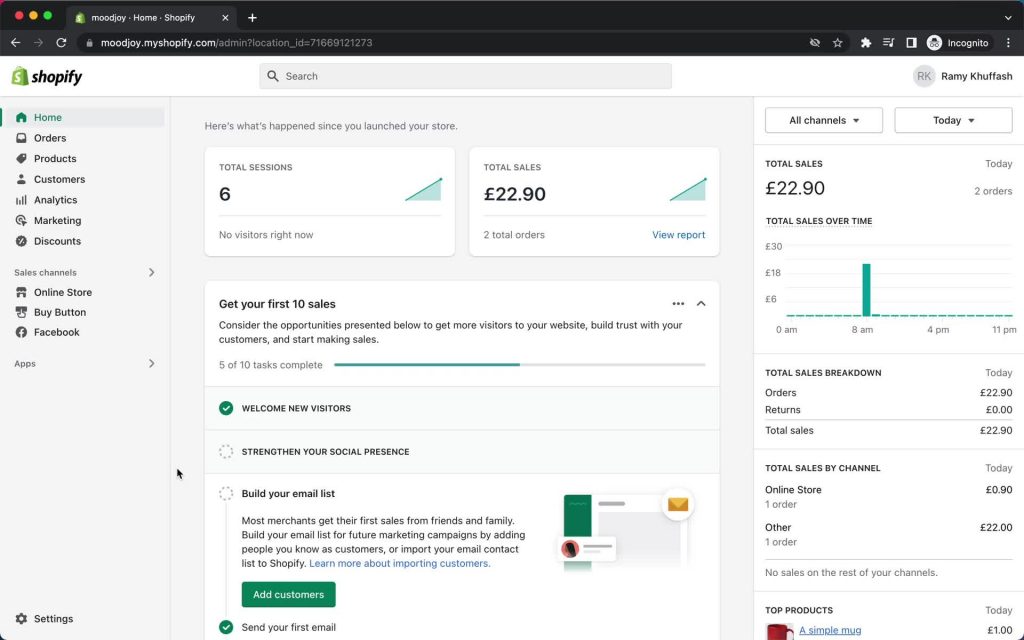
Shopify is excellent at commerce for handling products, orders, customers, checkout, and basic inventory availability.
However, as businesses expand, they often ask Shopify to become something it is not: a vendor purchase order system, an exception queue, or a replenishment planner.
The question is not whether Shopify can store this data, but whether Shopify should own the workflow. Without structured records, finding those answers becomes surprisingly difficult.
Best Inventory Management Software for Shopify in 2026
As Shopify stores grow, inventory, suppliers, purchasing, fulfillment, and warehouse activity all need to stay connected.
That is why many companies move beyond basic inventory tools and look for systems that provide greater visibility and control across their operations.
| Software | Best For | Strengths | Considerations |
| Shopify Inventory | Small stores. | Native integration, simple setup. | Limited operational workflows. |
| Zoho Inventory | Growing e-commerce businesses. | Multi-channel inventory management. | Less flexible for unique processes. |
| Cin7 | Complex inventory operations. | Strong purchasing and warehouse features. | Higher complexity. |
| Unleashed | Manufacturers and wholesalers. | Production and inventory control. | Can require significant setup. |
| Katana | Product-based businesses. | Manufacturing visibility. | Focused on production workflows. |
| NetSuite | Enterprise operations. | Broad ERP capabilities. | Expensive and resource-intensive. |
| AnyDB | Businesses with custom operational workflows. | Object-based records, flexible processes, collaboration, traceability. | Requires process design around operational needs. |
| QuickSync | Multichannel Shopify sellers who need accurate stock across every platform. | Real-time inventory sync, product sync, and centralized order management. | Focused on multichannel sync rather than manufacturing or purchasing workflows. |
What Features Matter Most?
Not every business needs the same software, but the best inventory management software for Shopify usually excels in a few key areas.
- Real-Time Inventory Visibility: Inventory data should stay current across locations, teams, and workflows. When everyone works from the same information, decisions become faster and more reliable.
- Multi-Location Support: Inventory rarely lives in a single warehouse. Stores, fulfillment centers, suppliers, and vehicles all become part of the operational picture.
- Purchasing and Supplier Management: Inventory software should connect stock levels with supplier activity, purchase orders, and replenishment decisions.
- Traceability and Audit History: When inventory changes, teams need to know what changed, who changed it, and why. Clear history reduces confusion and improves accountability.
- Flexibility: Every business handles inventory differently. The strongest systems adapt to operational reality instead of forcing teams into rigid workflows.
A common theme across e-commerce communities and industry reviews is that many Shopify business owners eventually outgrow basic inventory tracking.
The best solution is the one that matches how your business operates today and can continue supporting it as complexity grows.
Why AnyDB Is Different From Traditional Shopify Inventory Systems
Most inventory tools focus on inventory alone. But inventory rarely exists in isolation.
It connects to suppliers, purchase orders, warehouses, audits, and customer orders. As operations grow, managing those relationships becomes just as important as tracking stock levels.
That is where AnyDB takes a different approach.
Inventory as Connected Business Objects
AnyDB is an object-based platform that treats inventory as part of a larger operational system.
Each inventory item can contain:
- Stock information
- Warehouse location
- Supplier relationships
- Barcode information
- Attachments
- Transaction history
- Notes and activity
Instead of jumping between disconnected records, teams work with the complete inventory object in one place.
Inventory, Purchasing, and Operations Connected Together
Inventory records can connect to:
- Suppliers
- Purchase orders
- Warehouses
- Shipments
- Audits
- Fulfillment activities
- Special-order workflows for out-of-stock items
- Fulfillment exceptions and rework handling
This creates a single source of operational truth. No duplicate data entry. No conflicting reports. How AnyDB Supports Growing Shopify Operations
| Operational Need | How AnyDB Helps |
| Inventory tracking | Manage inventory as structured object-based records. |
| Supplier management | Link suppliers directly to inventory and purchasing records. |
| Warehouse visibility | Track inventory across various locations. |
| Stock movements | Record transfers, receipts, and adjustments with full history. |
| External collaboration | Provide secure access for suppliers and logistics partners. |
| Operational reporting | Monitor inventory activity in real-time through live dashboards and views. |
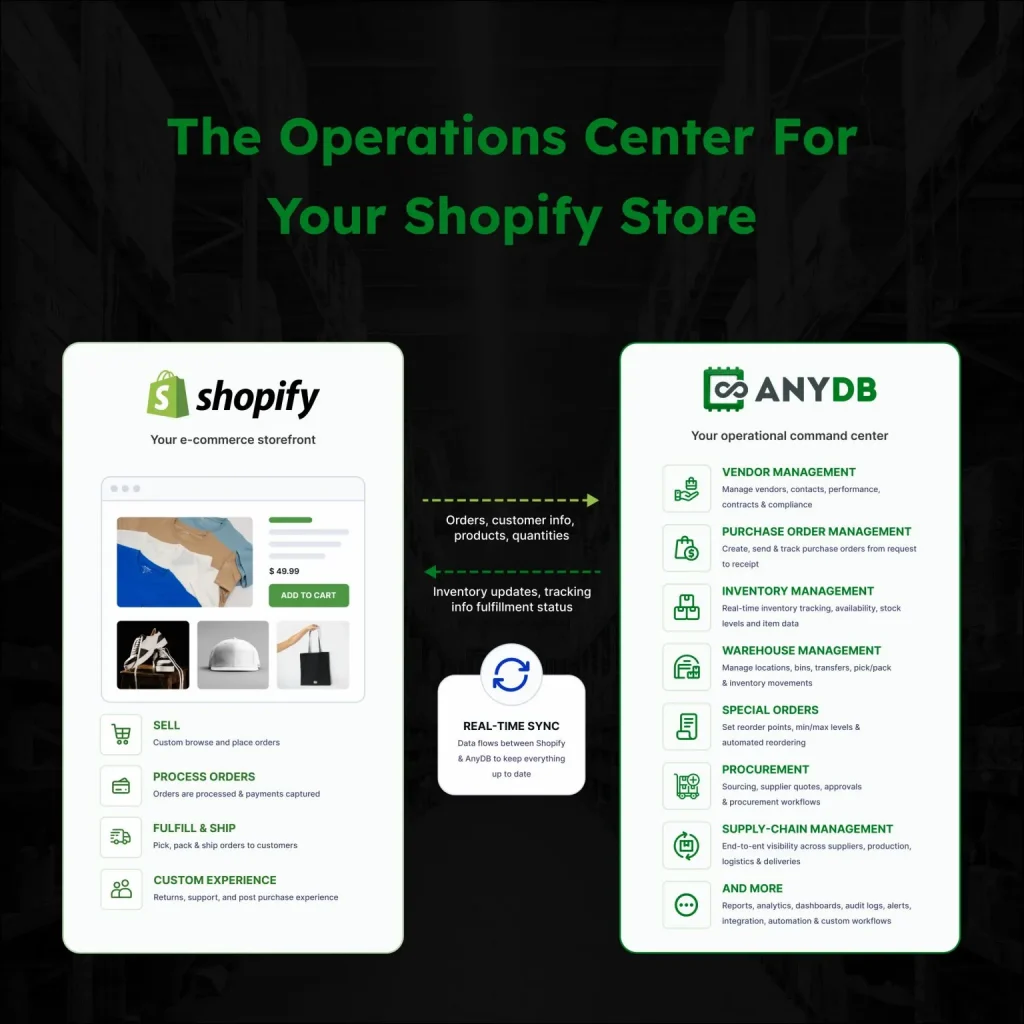
| Seamless Shopify Sync | The native AnyDB Sync app connects directly to your Shopify store, providing configurable, bi-directional syncing of products, orders, customers, and locations. It supports real-time updates via webhooks, ensuring your storefront and operational backend are never out of sync. |
Operational Visibility in Real-Time
Managers can quickly monitor:
- Inventory availability
- Stock movements
- Supplier activity
- Replenishment needs
- Operational bottlenecks
Without manually compiling reports from multiple systems. The result is simple: inventory management becomes part of a structured operational workflow, not a collection of disconnected tools.
Choose Inventory Software That Grows With Your Operations
When evaluating the best inventory management software for Shopify, look beyond stock counts. Consider how well the platform supports your day-to-day operations, adapts to your workflows, and helps teams work from a single source of truth.
With object-based records, connected operational workflows, real-time visibility, and secure collaboration, AnyDB helps businesses manage inventory as part of a complete operational system, not another disconnected tool.
Ready to bring more structure to your inventory operations?
Shopify handles the storefront, and AnyDB runs the operations behind it. To help you make the transition, AnyDB provides a completely guided, free 2-week setup where our team will map out and build your custom inventory workflows for you.
Plus, you can try the AnyDB Sync app with a 14-day free trial to see your Shopify data map directly into your new operational system.
Schedule a free call with the AnyDB team today to connect your inventory management and order fulfillment with confidence.

The End-to-End Operations System that Finally Fits Your Reality.
No more scattered spreadsheets or rigid, disconnected tools.
AnyDB is a modern, customizable platform for managing business records and operations across teams, clients, and partners.
Learn More


Phone: (512)-761-7979
© 2024 Humanly Inc. All rights reserved.
What is AnyDB?
AnyDB is a unified, customizable data store designed to streamline and empower your entire organization. Effortlessly store, organize, and share custom business data to drive both internal and external operations across teams. Think of it as spreadsheets on steroids.Perfect for Sales, Marketing, Operations, HR, and beyond. Discover AnyDB