
Published on February 24, 2026


An inventory control system becomes critical when stock turns into a liability due to the absence of clear rules.
A structured framework defines how stock is recorded, updated, monitored, and replenished. It determines what is available, where it is stored, and when action is required. Without it, procurement, warehousing, and fulfillment operate on assumptions instead of data.
As operations grow, control shifts from counting units to designing structured processes. The companies that scale sustainably are those that treat inventory as a governed data flow rather than a static spreadsheet.
What Is an Inventory Control System?
An inventory control system combines tools and processes to regulate stock throughout the procurement-to-sale lifecycle. It tracks incoming goods, monitors storage, logs outgoing movements, and signals when replenishment is needed.
To understand the inventory control system meaning, it helps to separate execution from strategy.
Inventory management focuses on planning, forecasting, and supplier coordination. Inventory control deals with operational precision. It ensures that every movement, adjustment, and replenishment is properly recorded and reflected in stock levels.
Control is what turns planning into reliable execution.
Why Inventory Control Systems Matter
Inventory has a direct impact on how a business performs day to day. When stock levels aren’t under control, the consequences show up quickly in cash flow, customer experience, and operational stability.
Too much inventory ties up working capital and increases storage costs. Too little leads to delays, backorders, and frustrated customers. And when data is inconsistent, teams waste time double-checking numbers instead of making decisions.
A well-structured control system helps bring order to this complexity. It improves:
- Stock accuracy;
- Financial visibility;
- Process reliability;
- Coordination across locations.
With clearer data and defined rules, purchasing becomes more intentional, fulfillment runs more smoothly, and leadership gains a dependable view of what’s happening across the supplier management without relying on assumptions.
Core Functions of an Inventory Control System
An effective system operates through interconnected functions. Tracking, receiving, fulfillment, forecasting, and replenishment are not isolated processes. Each depends on the integrity of the others.
When one function fails, the entire control structure weakens. See below how these elements work together to maintain balance and reliability.
Inventory Tracking and Visibility
Control begins with visibility. Knowing total stock is insufficient. Teams must understand distribution across warehouses, zones, or retail locations. Without location-level insight, transfer decisions and fulfillment planning become reactive.
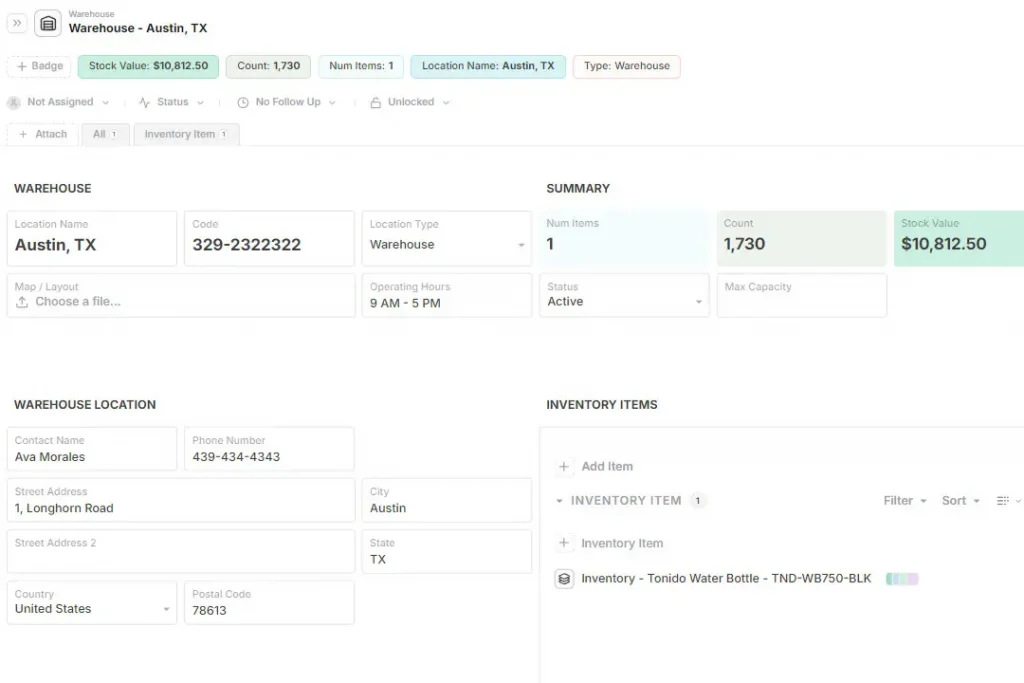
AnyDB calculates current quantities using transaction-based formulas. Instead of storing a static number, stock is derived from recorded movements. Live dashboards can be filtered by location or category, allowing managers to see precisely what sits in Austin versus New York at any moment.
This real-time clarity eliminates dependence on delayed reports and manual reconciliation.
Receiving and Putaway
Every inventory control system depends on accurate intake. Receiving errors propagate through the entire operation. If incoming goods are logged incorrectly, every downstream report becomes unreliable.
AnyDB supports QR code integration across records, allowing warehouse teams to scan items or bins and log Stock In transactions instantly. Entries are recorded at the loading dock, where the movement occurs.
Suppliers can also submit digital packing slips through integrated forms before arrival, reducing discrepancies during verification. Accurate intake protects the integrity of all subsequent tracking and reporting.
Order Fulfillment
Fulfillment reflects the effectiveness of tracking and receiving. When stock records are accurate and locations are clear, teams can reserve items, pick confidently, and record Stock Out movements without manual adjustments.
Each outbound transaction updates availability automatically. This prevents double allocation and reduces the need for corrective adjustments later.
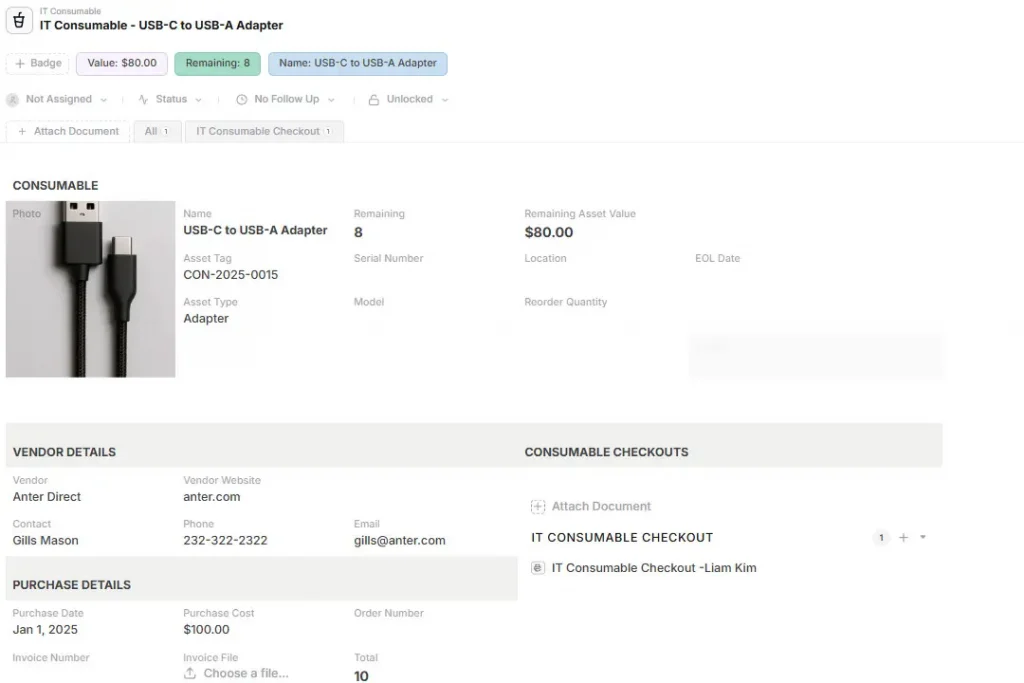
Templates such as the IT Consumable model demonstrate how items, usage logs, and locations remain connected within a single operational structure.
Demand Forecasting
Forecasting depends on historical accuracy. In many small and mid-sized operations, quantities are overwritten rather than logged. This eliminates traceability and limits analytical depth.
AnyDB records every movement as a distinct transaction. Over time, this builds a structured audit trail of sales velocity, seasonality, and replenishment cycles. Data can be exported for advanced modeling or visualized directly in dashboards.
Reliable history strengthens forecasting accuracy and supports strategic purchasing decisions.
Stock Optimization and Reorder Points
Tracking and forecasting converge in optimization. Control systems define minimum levels, reorder thresholds, and status indicators that guide procurement timing.
Instead of reacting to stockouts, teams receive structured signals when quantities fall below predefined limits.
Status fields such as Low Stock or Critical allow prioritization across categories and locations. This structured approach reduces excess purchasing while protecting service continuity.
What are the 4 types of inventory control?
Companies often ask about the types of inventory control systems and how they differ in practice:
- Perpetual Inventory Control System: Stock updates continuously after each transaction. Provides real-time accuracy and supports multi-location operations.
- Periodic Inventory System: Stock levels are updated at set intervals, often through physical counts. Simpler to manage but less responsive to daily fluctuations.
- Manual and Spreadsheet-Based Systems: Quantities are adjusted manually, often by editing cell values. Suitable for very small operations but prone to errors and limited traceability.
- Automated and Software-Based Systems: Use structured databases and transaction logs to update quantities automatically. Offer audit trails, reporting, and operational scalability.
When evaluating types of inventory management or inventory control systems, businesses must balance complexity, budget, and growth expectations.
Inventory Control Techniques and Methods
Beyond structural models, companies apply specific techniques to regulate stock levels and minimize risk.
- Min-Max Inventory Control: Defines minimum and maximum thresholds for each item. When stock reaches the minimum, replenishment is triggered. Works well for stable demand patterns.
- Just-in-Time (JIT): Inventory arrives only when needed for production or sale. Reduces holding costs but requires strong supplier coordination and precise scheduling.
- ABC Analysis: Classifies items by value and strategic importance. High-value items receive tighter oversight, while lower-impact items follow simplified control.
- FIFO and LIFO Methods: FIFO prioritizes selling older inventory first, reducing expiration risk. LIFO moves newer stock first and may influence accounting treatment depending on jurisdiction.
Each method involves trade-offs between capital efficiency, operational risk, and administrative effort.
Inventory Control System Examples in Practice
The way inventory control works in practice depends on the business model, but the principle remains the same: visibility enables better decisions.
- In retail, structured replenishment ensures shelves reflect demand velocity without accumulating dead stock;
- In manufacturing, materials control protects production continuity by monitoring component thresholds per work order;
- In multi-location businesses, centralized visibility allows managers to rebalance stock between sites rather than over-purchasing.
These inventory control system examples show how structured oversight supports both operational continuity and financial efficiency. When stock data is reliable, teams act proactively rather than reactively.
How AnyDB Supports Inventory Control Systems
Many tools focus on features. AnyDB focuses on structure. The platform is built on an object-based model, where real-world elements — products, locations, suppliers, movements — are treated as connected business records.
You define how stock moves in your environment, whether through receiving workflows, internal transfers, production consumption, or fulfillment, and the system reflects that reality.
Every Stock In and Stock Out entry becomes part of a traceable, contextual log. Unlike spreadsheets, where a number can change without explanation, each inventory adjustment in AnyDB is tied to a recorded action, a user, and a timestamp.
You gain clarity and control without adding unnecessary complexity.
Key capabilities include:
- Structured item records;
- Automatically recalculated quantities;
- Custom status indicators and reorder thresholds;
- Connected data across items, warehouses, and suppliers;
- Flexible views and filters for operational insight;
- Adaptable workflows without the rigidity of traditional ERP systems.
For teams that want to move beyond manual tracking, AnyDB offers a practical starting point. You can begin building an inventory control system free, test your structure, and scale as your operations grow.
If you’re ready to replace spreadsheets with structured visibility, schedule a demo call to see how AnyDB fits your operations!
Frequently Asked Questions About Inventory Control System
Below are some of the most common questions teams have about inventory control system.
What is ICS in the supply chain?
ICS stands for Inventory Control System. It refers to the operational framework used to monitor stock levels and record inventory movements within supply chain activities.
What are the key components of an inventory control system?
Core components include tracking mechanisms, transaction logging, reorder thresholds, reporting dashboards, and structured records linking items, locations, and suppliers.
Can small businesses use inventory control systems?
Yes. Early adoption prevents scaling problems. Even small operations benefit from structured tracking and defined replenishment rules.
Is a PLC an inventory control system?
No. A PLC controls industrial equipment. Inventory control systems manage stock data, movements, and replenishment processes.

The End-to-End Operations System that Finally Fits Your Reality.
No more scattered spreadsheets or rigid, disconnected tools.
AnyDB is a modern, customizable platform for managing business records and operations across teams, clients, and partners.
Learn More


Phone: (512)-761-7979
© 2024 Humanly Inc. All rights reserved.
What is AnyDB?
AnyDB is a unified, customizable data store designed to streamline and empower your entire organization. Effortlessly store, organize, and share custom business data to drive both internal and external operations across teams. Think of it as spreadsheets on steroids.Perfect for Sales, Marketing, Operations, HR, and beyond. Discover AnyDB