
Published on November 14, 2025


Struggling with scattered contracts, overlooked renewal dates, and manual approvals? A contract management software, especially true contract lifecycle management (CLM) solutions, streamline everything from intake to execution, storage, and renewal.
These systems offer centralized repositories, audit trails, and version control, eradicating risks and inefficiencies.
In this guide, you’ll learn what CLM entails, what features to look for, how to choose the right tool, and why AnyDB may deliver CLM-like control without the overhead of a traditional CLM system.
What Is Contract Management Software?
Contract management software is a centralized solution designed to manage every stage of a contract’s lifecycle, replacing manual processes.
Instead of scattered tools and manual steps, it centralizes everything in a structured workflow, ensuring visibility and control at each stage. And while the term contract management software (CMS) is sometimes used as a broad label for solutions that store or track agreements, a contract management software goes further by addressing the full lifecycle.
It not only acts as a repository but introduces automation, metadata management, analytics, and governance around key milestones such as approvals and renewals.
Most organizations begin managing contracts with shared drives, emails, and spreadsheets. That works in the early days, but as contract volume grows, this fragmented setup quickly creates risks: missed renewal dates, inconsistent versions, and the absence of an audit trail.
That’s when teams realize they’ve outgrown manual methods and need a system.
Key Features & Benefits (What to Look For)
If you understand which features make the difference between simply storing documents and truly turning contract management into a strategic process, you increase your chances of choosing the right platform.
For a CMS, core capabilities start with a centralized repository where all contracts are organized and easily accessible. This is complemented by:
- User-level permission controls;
- Document versioning;
- Redlining capabilities;
- Word add-ins;
- Clause libraries and configurable approval workflows.
Features such as e-signature, renewal and obligation tracking, audit trails, and advanced search ensure transparency and governance.
For instance, AI technologies can automatically extract metadata and flag risks; contract templates with variables and playbooks reduce repetitive work; and integrations with systems like CRM, ERP, AP, e-signature, email, and SSO connect contracts directly to broader operations.
The direct impact of these features shows in business outcomes such as shorter negotiation cycles, fewer errors, stronger compliance and governance, and tighter cost control thanks to visibility over renewal dates and contractual obligations.
5 Contract Management Software Options to Consider
As contract volumes grow, teams quickly realize that spreadsheets, emails, and scattered folders can’t keep up with the demands of approvals, renewals, and compliance.
Today’s CLM tools vary widely, from lean, ops-focused platforms to enterprise-grade solutions built for legal teams. Below are five options worth considering, each with its own strengths and trade-offs.
1. AnyDB
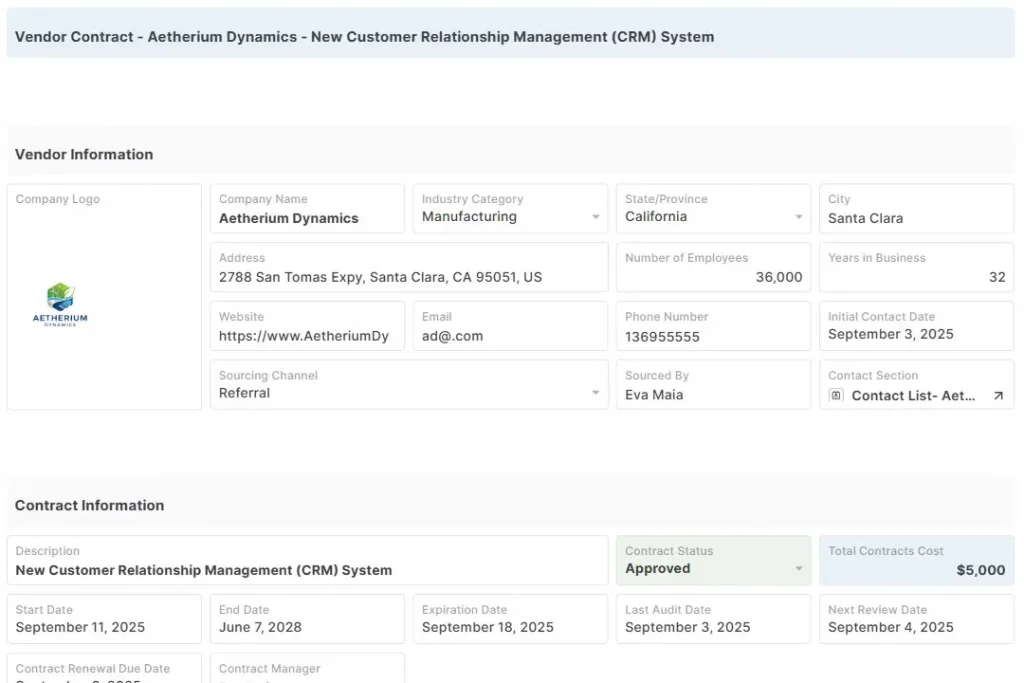
AnyDB is an operational management platform that also serves as a contract management solution for teams needing to link contracts directly to vendors, purchase orders, invoices, and approval workflows.
Blending the simplicity of a spreadsheet with the power of a relational database, it helps teams organize contracts alongside the financial and operational data that drive those agreements.
Best for Ops-heavy teams that need contracts tightly linked to vendors, POs, invoices, and approvals.
Why it stands out
AnyDB combines the familiarity of a spreadsheet-like interface with the structure of relational records, but what truly sets it apart is its portal model.
Unlike tools that bolt portals on top of disconnected tables, AnyDB lets you share the exact same live records your internal teams use, with no data duplication or fragile integrations.
Teams can set granular permissions (down to the cell, record, or table level), ensuring each vendor, auditor, or partner sees only what’s intended.
Portals are secure by design, easy to update, and instantly reflect any internal workflow change: a major advantage for contract-heavy processes where access requirements change frequently.
Built-in forms streamline intake, renewals, and document submissions, and every interaction automatically attaches to the correct record.
Add to that unlimited free guest collaborators and full audit trails with version history, and you get a contract management environment that is both controlled and flexible, without the overhead of traditional CLMs or ERPs.
How it fits CLM
Contracts can be requested via forms, routed for approval, stored with related files, and tracked with renewal dates and obligations as fields. Integrations with DocuSign or Adobe Sign via Zapier, Make and our open API extend e-signature capabilities, while vendor management links contracts directly to finance records.
Watch-outs
AnyDB doesn’t include a native e-signature tool, its advanced no-code automations are still evolving, and offline access is not supported.
2. Ironclad
Ironclad is a contract management platform designed for legal teams that need a robust system for contract drafting, approval routing, and playbook management. The platform focuses on streamlining complex legal processes while ensuring full auditability and efficient review and negotiation workflows.
- Best for: Legal teams prioritizing robust authoring, workflows, redlining, and playbooks.
- Why it stands out: Ironclad provides an intuitive interface for legal teams, with strong approval routing, ready-made templates, customizable playbooks, and advanced audit and analytics capabilities.
- How it fits CLM: Contracts can be drafted, reviewed, and approved entirely within the platform, maintaining version control and a complete change history. Playbooks automate repetitive steps, while dashboards and reports provide insights into performance and risk.
- Watch-outs: May require more administrative oversight and change management; the legal-focused depth can limit direct linking to operational or financial data.
3. Agiloft
Agiloft is a highly configurable contract management software designed for organizations that require complex approval logic, obligation tracking, and customizable workflows. It’s ideal for teams handling large-scale contracts or cross-functional processes.
- Best for: Highly configurable CLM with complex approval logic and obligation tracking.
- Why it stands out: Agiloft stands out for its flexible data model, advanced rules engine, and deep metadata and reporting capabilities. It enables automation of complex processes and provides granular oversight throughout the entire contract lifecycle.
- How it fits CLM: Contracts can be set up with conditional approval flows, obligation tracking, and renewal alerts. Detailed reports and customizable dashboards provide complete visibility for managers and teams.
- Watch-outs: Complex implementation; requires advanced administrative knowledge; steeper learning curve for less technical teams.
4. ContractWorks
ContractWorks is a contract management solution designed for teams that need a simple, secure repository with e-signature capabilities and expiration alerts. The platform prioritizes fast deployment and ease of use, perfect for teams seeking functionality without complexity.
Best for: Teams needing a straightforward repository with signatures and reminders.
- Why it stands out: ContractWorks offers quick setup, secure contract storage, e-signature functionality, and automatic alerts for milestones and renewals. It’s ideal for teams that want organized contracts and visibility over critical deadlines without operational overhead.
- How it fits CLM: Contracts can be stored with version history, obligation and renewal notifications can be configured, and integrated e-signatures managed. The streamlined interface ensures even smaller teams can operate efficiently.
- Watch-outs: Limited advanced contract authoring and AI capabilities; integration with operational or financial workflows is restricted.
5. Gatekeeper
Gatekeeper is a vendor-focused contract management platform, designed for controlling contracts with suppliers, including vendor records, renewals, and workflows. It’s ideal for teams that need visibility into supplier relationships and compliance processes.
- Best for: Vendor-centric contract control with supplier records and renewals.
- Why it stands out: Gatekeeper provides a vendor repository, lifecycle alerts, configurable workflows, and integrations with other business tools. It helps teams manage suppliers, monitor renewals, and ensure approval processes are followed.
- How it fits CLM: Contracts linked to vendors can be tracked, expiration alerts set, approval flows created, and documents centralized. Integrations connect the CLM to ERP and CRM systems.
- Watch-outs: Depth of redlining and AI features may vary; ensure it meets advanced legal drafting and review requirements.
How to Choose the Best Contract Management Software
Choosing the right contract management software goes far beyond comparing prices or isolated features. You need to evaluate how the tool fits into your team’s operational workflow and meets the needs of legal, operations, and finance:
- Team & volume: Start by assessing who will own the contracts. Legal teams may require robust drafting and review features, while operations teams focus on workflow, linking to vendors, POs, and payments. Also consider contract volume and how many departments will be involved in the lifecycle.
- Authoring & review: Check if the platform offers word add-ins, clause libraries, playbooks, and an intuitive negotiation experience. These features reduce rework and ensure consistency across documents.
- Metadata & AI: Advanced solutions use OCR for legacy documents, auto-tag critical fields (counterparty, terms, auto-renewals), and provide risk reports. This allows teams to track important information without manual effort.
- Workflows: Evaluate whether the software allows creation of request forms, conditional approvals, SLA timers, and automated escalations.
- Integrations: A good CLM should connect with CRM (Salesforce, HubSpot), ERP/AP (invoices, POs), e-signature tools, identity systems (SSO/IdP), and email. Integrations reduce duplication and ensure data flows seamlessly across systems.
- Permissions & audit: Granular control by role, table, field, or file is essential. Look for platforms that maintain complete audit logs for traceability and compliance.
- Renewals & obligations: Alerts, automated tasks, and visual dashboards help manage critical deadlines and contractual obligations.
- Total cost & administration: Consider not only per-seat pricing but also the number of external guests, implementation effort, and ongoing maintenance.
- Data model: Check whether contracts can be linked to vendors, invoices, assets, or other operational records. If you need contracts to live alongside finance records, with real-time data, AnyDB can be deployed faster than a full CLM.
What Else You Need to Know About Contract Management Software
These common questions should clarify the role of contract management software and how it differs from other solutions:
What is a contract management software?
It’s a platform that manages the full contract lifecycle, from request and drafting to approvals.
Is SAP a CLM?
SAP provides contract functionalities within its ecosystem, but dedicated CLM tools focus on authoring, workflows, and obligation tracking.
What is the difference between CMS and CLM?
CMS is a generic term for contract or content management. CLM covers the full lifecycle, including workflows, metadata, audit logs, and risk analytics.
Does Microsoft have a contract management tool?
Microsoft allows contract workflows via SharePoint/Power Platform, but third-party CLMs provide deeper end-to-end lifecycle features.
Can Jira be used for contract management?
Jira can track tasks and approvals through add-ons but isn’t built for full contract management. A CLM or ops-centric platform like AnyDB ensures governance and links to vendor and finance records.

The End-to-End Operations System that Finally Fits Your Reality.
No more scattered spreadsheets or rigid, disconnected tools.
AnyDB is a modern, customizable platform for managing business records and operations across teams, clients, and partners.
Learn More


Phone: (512)-761-7979
© 2024 Humanly Inc. All rights reserved.
What is AnyDB?
AnyDB is a unified, customizable data store designed to streamline and empower your entire organization. Effortlessly store, organize, and share custom business data to drive both internal and external operations across teams. Think of it as spreadsheets on steroids.Perfect for Sales, Marketing, Operations, HR, and beyond. Discover AnyDB