
Published on February 25, 2026


Vendor risk management usually becomes urgent when visibility is already gone. That means:
A critical supplier fails.
An audit requests evidence that cannot be traced back.
An incident reveals that past evaluations no longer reflect reality.
In most companies, the issue is not missing information, but fragmentation. Vendor data lives across spreadsheets, isolated contracts, inboxes, and disconnected tools.
Treating third-party risk as a lifecycle process changes this dynamic. Instead of relying on isolated assessments or annual reviews, organizations manage exposure through connected records, historical traceability, and continuous governance.
What Is Vendor Risk Management?
Vendor risk management is the structured process used to identify, assess, monitor, and mitigate risks associated with external vendors and partners that influence business operations.
In a third party vendor risk management context, this includes operational, compliance, security, financial, and reputational exposure.
This discipline defines how vendor-related decisions are made and revisited over time. Initial assessments, contract changes, incidents, ongoing performance, and offboarding activities remain linked within a single system.
When structured correctly, this approach becomes a vendor risk management program that defines how vendors are evaluated, approved, monitored, and exited across their full lifecycle.
Why Is Vendor Risk Management Important?
Organizations rely on vendors to run core processes, handle sensitive data, and support critical operations. As this reliance grows, so does exposure to risks that sit outside direct control but still fall under the company’s responsibility.
Regulatory frameworks such as GDPR, HIPAA, SOC 2, and ISO audit require continuous oversight of third parties with system or data access. Without structured monitoring, producing consistent evidence becomes slow and unreliable.
A well-designed vendor risk management solution improves security posture, strengthens compliance, supports continuity, and reduces operational disruption. It also replaces intuition-based decisions with documented history and accountability.
Types of Vendor Risks to Manage
A reliable vendor risk assessment recognizes that exposure evolves over time. As vendors gain access, responsibility, and operational relevance, risk changes.
An effective vendor risk management software supports this evolution across multiple dimensions.
Cybersecurity and Data Risk
Cybersecurity risk includes data leaks, unauthorized access, malware, and improper handling of sensitive information. In many cases, risk is introduced during document exchange through email or shared folders.
AnyDB addresses this by keeping vendor data inside a single encrypted environment built on Zero-Trust principles.
Through Secure Client and Vendor Portals, vendors upload compliance documents such as SOC 2 reports or ISO certifications directly into structured records, without exposing internal systems or relying on insecure channels.
Operational Risk
Operational risk emerges when delivery failures, recurring delays, or vendor dependency affect continuity. These issues usually form patterns that go unnoticed when performance is not tracked over time.
Structured records allow teams to identify trends early and act before operations are disrupted.
Compliance and Legal Risk
Compliance risk stems from expired certifications, missing insurance coverage, or contractual obligations that are no longer monitored after signature. When contracts, documents, and reviews remain disconnected, issues surface during audits or incidents.
Reputational Risk
Reputational exposure arises when vendor practices conflict with ethical, environmental, or social expectations. Without traceable evaluations and documented decisions, these situations escalate quickly and damage trust.
Managing these risks through connected records turns assessment into an ongoing oversight mechanism.
The Vendor Risk Management Lifecycle
A sustainable program follows vendors from first contact through offboarding. Risk changes as access levels and operational dependency evolve and lifecycle management ensures continuity and audit readiness.
Vendor Due Diligence & Onboarding
Risk oversight starts before approval. This phase includes questionnaires, certifications, and basic compliance checks. Collection often slows down when handled through emails and PDFs.
In AnyDB, vendor record templates can be converted into public or private forms. Vendors submit banking details, tax information, and compliance documents directly into the system.
Data populates structured records automatically, while connected onboarding checklists confirm that risk criteria are met before approval.
See how this works in practice in the video below, which walks through creating and sharing vendor onboarding forms step by step in AnyDB:
Risk Identification and Categorization
Once onboarding is complete, vendors are classified by exposure level. Operational, financial, and compliance risks are grouped to define review frequency and escalation paths.
With structured data, categorization relies on documented history, incidents, and performance rather than subjective judgment.
Continuous Vendor Risk Monitoring
Risk does not wait for annual reviews. It appears in late deliveries, incidents, expired documents, or contract changes.
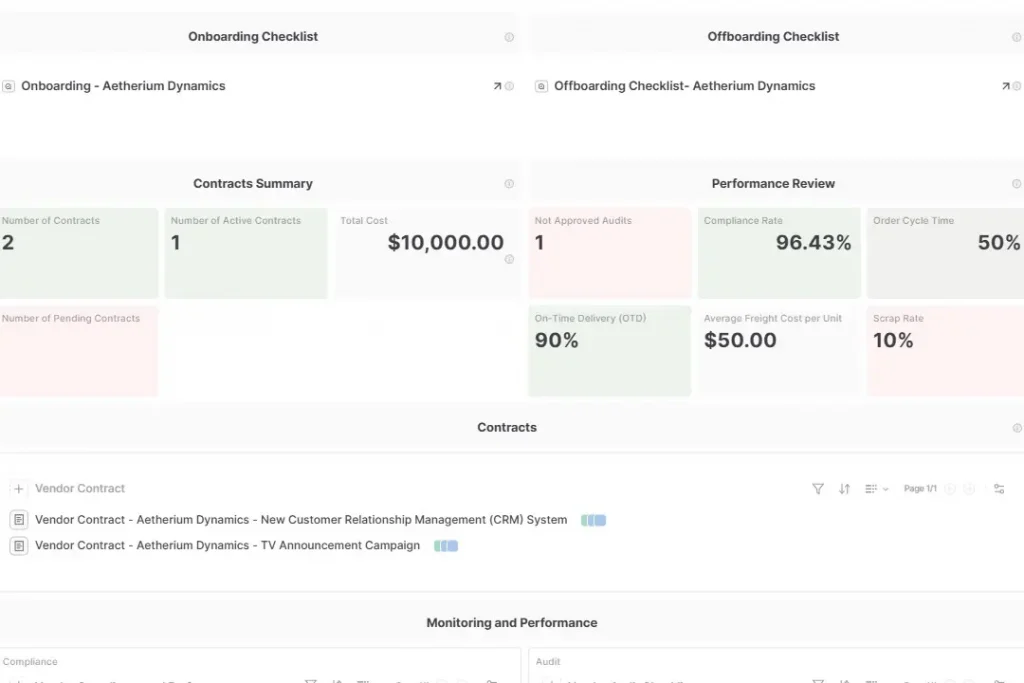
AnyDB supports continuous oversight through follow-up dates, automated reminders, and real-time vendor dashboards that surface high-risk vendors and expired certifications without manual reporting.
Contract and Obligation Management
Contracts concentrate risk through clauses, regulatory requirements, and SLAs. Linking contracts directly to vendor records keeps obligations aligned with assessments and performance data.
This connection ensures consistency between agreements and actual oversight.
Offboarding and Risk Closure
Ending a vendor relationship requires formal risk closure. Informal offboarding leaves access active and obligations unclear.
The Vendor Offboarding Checklist structures this phase with traceable steps tied to vendor and contract records, including access revocation, document closure, and final validation.
Vendor Risk Management Frameworks and Models
Risk frameworks provide structure but depend on execution. Models such as the 5 P’s of risk management (Purpose, People, Process, Platforms, and Performance), help identify ownership and weak points. Their value increases when supported by reliable records and monitoring.
Common frameworks like COSO, ISO 31000, the NIST Risk Management Framework, and OCEG GRC guide risk treatment across industries. Their effectiveness relies on systems that connect data, contracts, audits, and evidence.
How AnyDB Enables End-to-End Vendor Risk Management
AnyDB is an object-based business platform designed to structure and run complex operations with connected records, relationships, files, and workflows.
Vendor records form the foundation, linking contracts, invoices, assessments, incidents, and audit evidence across the entire lifecycle. Flexible templates support different risk categories and operational contexts. Role-based permissions protect sensitive information.
Secure Client and Vendor Portals play a central role in reducing friction and exposure at the point where companies and vendors interact. Compliance documents, RFPs, and financial data are submitted directly into the platform, encrypted and fully traceable.
Dashboards and reminders provide continuous visibility, while structured workflows keep onboarding, monitoring, and offboarding aligned.
The video below shows how teams set up secure customer, vendor, and partner portals in AnyDB, and how permissions and data access are managed across the full vendor lifecycle:
Frequently Asked Questions About Vendor Risk Management
These questions address common concerns teams have when structuring and maintaining vendor risk oversight.
How to do a vendor risk assessment?
A vendor risk assessment starts during onboarding by collecting structured data on compliance, data access, and operational impact. Risk levels are defined based on exposure and updated as performance, incidents, and contracts evolve.
What tools are used for vendor risk management?
Vendor risk is managed using systems that store supplier records, compliance documents, assessments, and contracts in one place. Connected databases and workflows support ongoing oversight better than isolated questionnaires or spreadsheets.
How do you monitor vendor risk?
Vendor risk is monitored by tracking document expirations, incidents, contractual obligations, and performance changes. Alerts, follow-up dates, and live dashboards help teams identify issues without waiting for annual reviews.

The End-to-End Operations System that Finally Fits Your Reality.
No more scattered spreadsheets or rigid, disconnected tools.
AnyDB is a modern, customizable platform for managing business records and operations across teams, clients, and partners.
Learn More


Phone: (512)-761-7979
© 2024 Humanly Inc. All rights reserved.
What is AnyDB?
AnyDB is a unified, customizable data store designed to streamline and empower your entire organization. Effortlessly store, organize, and share custom business data to drive both internal and external operations across teams. Think of it as spreadsheets on steroids.Perfect for Sales, Marketing, Operations, HR, and beyond. Discover AnyDB