
Published on January 28, 2026


When people search for HVAC contractor software, they are usually looking for ways to organize operations, improve efficiency, and gain more control over growing complexity.
Scheduling, dispatch, invoicing, and technician workflows are often the first pain points that come to mind. But as HVAC companies grow, the real operational challenges tend to live elsewhere. Contracts scattered across folders, vendors managed in spreadsheets, compliance documents stored outside the systems that run daily operations, and invoices that are hard to validate against contractual terms.
This article looks at HVAC contractor software from a broader operational lens. First, we align with what the market traditionally considers HVAC software.
Then, we explore the critical gaps most tools leave behind and why vendor, contract, and compliance management have become the missing backbone for modern HVAC operations.
What Is HVAC Contractor Software?
HVAC contractor software refers to tools designed to help heating, ventilation, and air conditioning businesses manage their daily operations efficiently. These platforms replace manual processes with structured workflows, dashboards, and automation.
Traditionally, HVAC contractor software focuses on field execution and service delivery. Common areas covered include:
- Scheduling and dispatch to assign jobs to technicians;
- Mobile workflows that support work orders in the field;
- Invoicing and payment processing; and
- Basic customer relationship management with service history tracking.
Many platforms also integrate with accounting systems to support billing and financial reporting. For small and mid sized teams, these capabilities often represent a major step forward compared to spreadsheets and paper based processes.
However, most HVAC contractor software is optimized for what happens on the job site. It is built to manage technicians and service calls, not to manage vendors, contracts, or long term compliance obligations.
Another issue is that these tools usually make it difficult to change the system layout to match their businesses specific needs.
These challenges become critical as HVAC businesses scale, work with subcontractors, need deeper customization, or operate in regulated commercial environments.
Core Features Found in Traditional HVAC Contractor Software
Most tools in the HVAC software category share a common feature set centered on field service management. These capabilities are well established and widely adopted across the industry.
Scheduling and Dispatch
Dispatch boards and calendars allow teams to assign jobs, optimize routes, and manage technician availability. This is often the core value proposition of field service platforms.
Mobile Apps for Technicians
Mobile access enables technicians to view work orders, capture job details, upload photos, and collect customer signatures directly from the field.
Invoicing and Payments
Many platforms generate invoices automatically from completed jobs and support online payments, reducing billing delays and manual follow ups.
Customer Management CRM
Basic HVAC CRM software functionality includes customer records, service history, and communication logs. This helps teams maintain continuity across recurring service calls.
Accounting Integrations
Connections with HVAC accounting software such as QuickBooks allow invoices and payments to sync with financial systems, streamlining bookkeeping.
If the application doesn’t offer a native integration, it should at least provide alternatives through platforms like Zapier or Make.
Reporting and KPIs
Dashboards typically focus on operational metrics like job completion rates, technician utilization, revenue per job, and response times.
Well known tools such as Jobber, Housecall Pro, FieldEdge, Service Fusion, Workiz, Podium, and Thermal Grid fit squarely into this model. They provide strong support for field execution and customer service, which is exactly what they are designed to do.
The Operational Gap in Most HVAC Contractor Software
As HVAC companies grow, a large part of day to day operations begins to depend on an extended network of third parties and long term commitments. In HVAC operations, especially in the commercial segment, this typically includes:
- External contractors and subcontractors responsible for specific service scopes;
- Equipment and parts suppliers operating under different contracts, terms, and conditions;
- Recurring maintenance vendors, often governed by service level agreements (SLAs);
- Certifications, insurance policies, and compliance documents required by clients and regulators;
- Service level agreements that directly impact billing, penalties, and renewals.
Despite their importance, these elements are rarely managed inside traditional field service management tools. As a result, the operational focus remains on service execution rather than on the governance layer that sustains the business over time.
This disconnect leads to common operational gaps:
- Contracts stored as standalone PDFs in shared drives or folders;
- Vendor data duplicated across spreadsheets, ERPs, and financial systems;
- No clear linkage between vendor, contract, invoice, and audit records;
- Missed renewals or renewals handled reactively;
- Compliance risks caused by expired or outdated documentation;
- Manual, slow, and error prone audit processes.
It is important to clarify that this scenario is not the result of failure in existing HVAC tools. Instead, it reflects an operational blind spot. Most HVAC contractor software is designed to manage work orders and technicians, not to control contracts, vendors, and ongoing obligations in complex environments.
Vendor and Contract Management: The Missing Layer in HVAC Software Stacks
In response to these modern challenges, HVAC companies increasingly need structured vendor and contract lifecycle management.
This layer treats vendors and contracts as operational assets that are directly connected to financial workflows, compliance requirements, and audit routines.
A structured approach to vendor and contract lifecycle management for HVAC typically includes:
- Vendor onboarding and qualification with clear criteria and centralized history;
- Management of contract terms and obligations, linking responsibilities, SLAs, and commercial conditions;
- Renewal and expiration tracking with proactive alerts and visibility;
- Invoice validation against contractual terms, reducing disputes and overpayments;
- Compliance documentation such as insurance, certifications, and licenses kept continuously up to date;
- Audit logs and decision trails that ensure traceability;
- Complete historical records connecting vendors, contracts, service periods, and financial data.
Without this structure, HVAC companies can continue operating, but they lose visibility, predictability, and control. With it in place, vendors and contracts become part of a solid, scalable operational foundation rather than a hidden source of risk.
How AnyDB Works as HVAC Contractor Software (Beyond Field Service)
AnyDB works as the system of record for the data that sustains HVAC operations over time, especially the information that does not live inside traditional field service tools. This includes:
- Vendors
- Contracts
- Compliance
- Invoices
- Audits
Instead of fragmenting this information across spreadsheets, shared folders, ERPs, and disconnected tools, AnyDB organizes everything into a structured, connected, and audit ready database. Below, we break down how this works in practice.
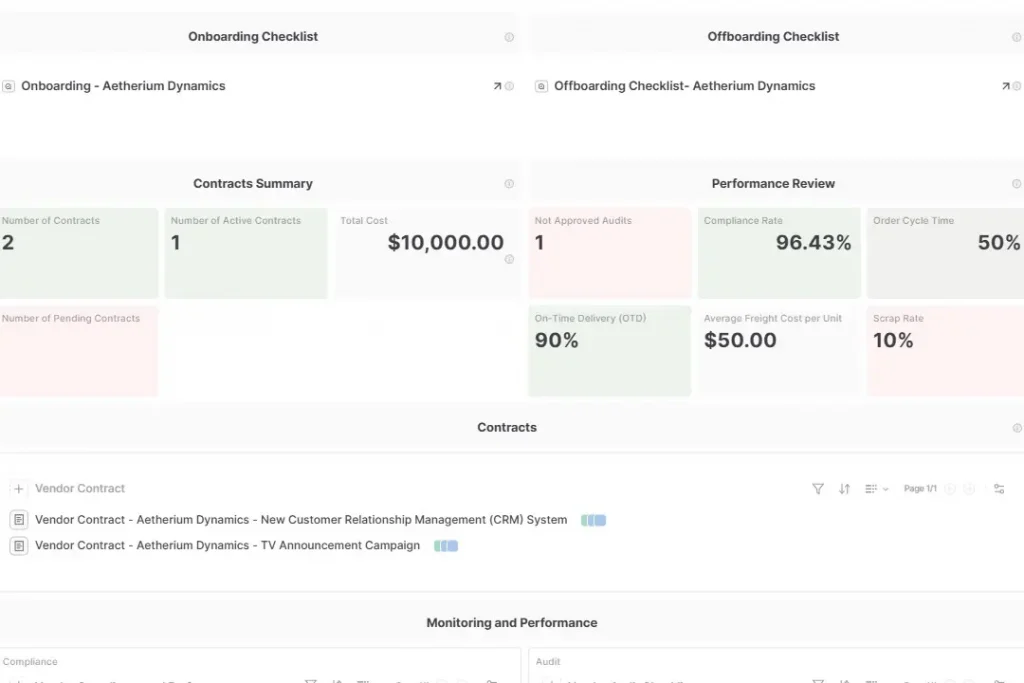
Vendor Management for HVAC Contractors
Vendor management is one of the most sensitive areas of HVAC operations, especially when subcontractors, equipment suppliers, and recurring service providers are involved. With AnyDB, companies centralize:
- Complete vendor records in a single location;
- Tracking of certifications, insurance, and required documentation;
- Approved vendor lists by service type or site;
- Performance history, relationship records, and incidents.
This information no longer exists as scattered data. It becomes part of structured records, with clear relationships between vendors, contracts, service locations, and service periods, as illustrated in the video below:
Contract Lifecycle Visibility
In HVAC operations, contracts define timelines, obligations, pricing, SLAs, and rules that directly impact billing and compliance. With AnyDB, companies gain full visibility into the contract lifecycle through structured information such as:
- Clearly defined contract start and end dates;
- Configurable renewal and expiration alerts;
- Contracts directly linked to vendors, assets, and locations;
- Contract terms connected to the corresponding invoices.
This visibility reduces risk and shifts contract management from a reactive task to a controlled operational process.
Invoice & Audit Traceability
Another big challenge in HVAC operations is validating invoices accurately, especially when multiple vendors and contracts are involved. In AnyDB, each invoice can be structurally linked to:
- A specific vendor;
- An active contract;
- A defined service period.
This model creates an audit ready history with full traceability and significantly reduces manual checks. Disputes are resolved based on connected data, not by searching through PDFs or old emails.
Flexible Structure for Commercial HVAC
AnyDB is designed to adapt to the flexible reality of HVAC operations, where each company combines sites, vendors, contracts, and regulatory requirements in its own way. The platform supports:
- Multiple operational sites;
- Multiple vendors per site;
- Complex compliance requirements;
- Structures that do not rely on rigid FSM workflows.
With relational data, templates, and live dashboards, the platform follows the company’s operational model instead of forcing operations to adapt to the software.
Bring clarity to your HVAC vendor and contract operations with AnyDB!
Frequently Asked Questions About HVAC Contractor Software
Below are answers to the most common questions about HVAC contractor software.
Is there HVAC software for commercial contractors?
Yes, but commercial operations require more than service call management. They demand deep control over contracts, vendors, SLAs, and compliance, areas that typically fall outside the scope of traditional field service tools.
Can HVAC software manage subcontractors and vendors?
Only to a limited extent. Most FSM tools register vendors merely as contacts. AnyDB fills this gap by structuring vendors, documents, contracts, and historical data within a single connected system.
How do HVAC companies track contracts and renewals?
Through contract lifecycle management. This includes structured dates, automated alerts, vendor links, and continuous visibility into obligations and expirations, something that is difficult to maintain with spreadsheets.
Do HVAC contractors still use spreadsheets?
Yes, especially for managing contracts and vendors. The issue is that spreadsheets lack traceability, access control, and reliable alerts. Structured databases like AnyDB reduce risk and increase operational predictability.

The End-to-End Operations System that Finally Fits Your Reality.
No more scattered spreadsheets or rigid, disconnected tools.
AnyDB is a modern, customizable platform for managing business records and operations across teams, clients, and partners.
Learn More


Phone: (512)-761-7979
© 2024 Humanly Inc. All rights reserved.
What is AnyDB?
AnyDB is a unified, customizable data store designed to streamline and empower your entire organization. Effortlessly store, organize, and share custom business data to drive both internal and external operations across teams. Think of it as spreadsheets on steroids.Perfect for Sales, Marketing, Operations, HR, and beyond. Discover AnyDB