What is AnyDB?
AnyDB is an object-based platform for managing custom business operations.
Most software forces work into rigid tables, fixed modules, or predefined workflows. Real operations do not work that way. They are made up of things that belong together and things that relate to each other.
AnyDB lets you model your business the way it actually runs.
The problem AnyDB solves
Operational data is usually fragmented:
- Information spread across spreadsheets, tools, folders, and emails
- Records split across multiple tables that only make sense when joined
- Files and notes disconnected from the data they belong to
- Systems that break when workflows evolve
AnyDB replaces this with complete, connected business records.
How AnyDB is different
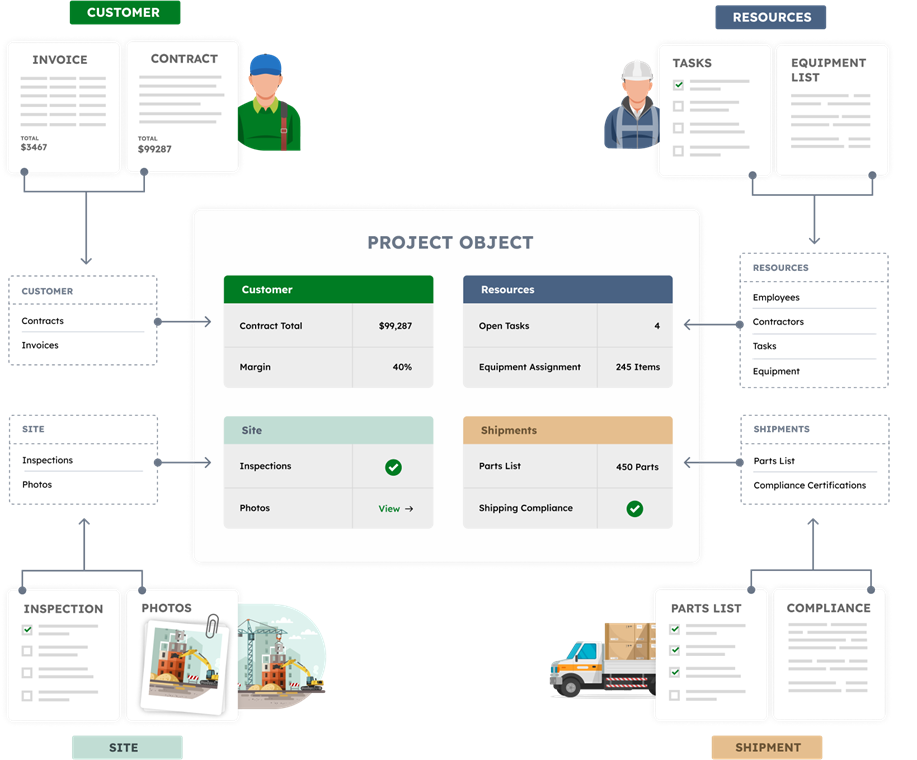
AnyDB is built around objects.
An object represents a real business thing, such as:
- a customer
- a project
- a warehouse
- an asset
- an order
- an inspection
Each object can:
- contain related objects
- link to other objects
- hold its own fields, files, comments, and history
You do not assemble data later separately.
You work with the full object directly.
Example AnyDB model
Who AnyDB is for
AnyDB is designed for operational teams running businesses, projects, or processes that involve many interconnected things.
Typical users include:
- operations managers
- project managers
- finance and procurement teams
- logistics and inventory teams
- compliance and quality teams
If you understand your process, you can model it in AnyDB.
Why the Object Model is intuitive
-
More intuitive than relational models
You think in terms of objects and real world items: Project->Vendors->Contracts -
Non-developers can build confidently
No need to understand joins or schema design. Attaching objects feels natural. -
Model complex systems quickly
Factories, regions, products, shipments, all can be represented in AnyDB. -
Easy to extend and expand
Add new fields, attach new objects, or reshape the model without breaking anything. -
Objects can be worked on independently
Each object has its own fields, files, activity, and history. -
Objects can reference each other in formulas
A project can pull data from its customer, vendor, or parent program.
This is why AnyDB’s model aligns far better with how real businesses operate.