
Published on February 13, 2026


As organizations expand their network of external partners, vendor compliance management moves from a supporting task to a core operational function. Legal obligations, contractual requirements, and internal policies must be monitored consistently throughout the relationship, not only at onboarding.
In many companies, issues arise because compliance is treated as a set of disconnected artifacts. Certificates expire, audits turn into last-minute fire drills, and ownership over ongoing requirements remains unclear.
To be effective, third-party compliance must operate as a continuous discipline. Beyond checking requirements, it establishes processes, ownership, and traceability that allow organizations to maintain real control over suppliers across the entire lifecycle.
What Is Vendor Compliance Management?
Vendor compliance management refers to the structured approach used to ensure suppliers consistently meet legal, contractual, and internal requirements throughout the business relationship. Its focus extends beyond collecting documents to maintaining control, accountability, and auditability in daily operations.
A clear distinction exists between basic compliance requirements and the management of compliance itself. Requirements typically involve evidence such as certificates, policies, or attestations. The management layer defines ownership, verification workflows, review cycles, and the handling of exceptions.
In practice, this discipline embeds compliance into the supplier lifecycle. From onboarding and periodic reviews to regulatory updates, renewals, and offboarding, each stage is monitored and documented in a structured way.
A structured way, however, only becomes truly effective when compliance is treated as part of the real operational fabric of the business. Vendors are not folders. Certificates are not loose files. Reviews are not isolated tasks.
They are real-world objects connected to other objects: contracts, approvals, payments, incidents, and workflows.
AnyDB’s object-based approach reflects this reality. Each vendor is a living record, linked to its documents, status fields, responsible owners, and operational history.
Why Vendor Compliance Management Matters
As vendor ecosystems grow, so do operational dependencies, regulatory exposure, and risk concentration. Without a structured oversight model, information fragments, responsibilities blur, and decisions rely on incomplete or outdated data.
A mature approach delivers tangible benefits:
- Lower legal, financial, and reputational exposure through consistent controls and traceable evidence;
- Improved operational efficiency by replacing manual follow-ups with defined processes;
- Higher quality and consistency through enforceable standards;
- Cost avoidance by preventing fines, service interruptions, and emergency remediation.
Most importantly, structured oversight enables scale. As contracts, obligations, and third parties multiply, only well-defined processes preserve governance, control, and confidence in decision-making.
Key Areas of Vendor Compliance Management
Effective oversight relies on clearly defined operational areas that support continuous control, accountability, and audit readiness across the supplier lifecycle.
Rather than one-off checks, the model is designed to anticipate risk, organize information, and reduce friction during reviews or audits.
Risk Mitigation and Assessment
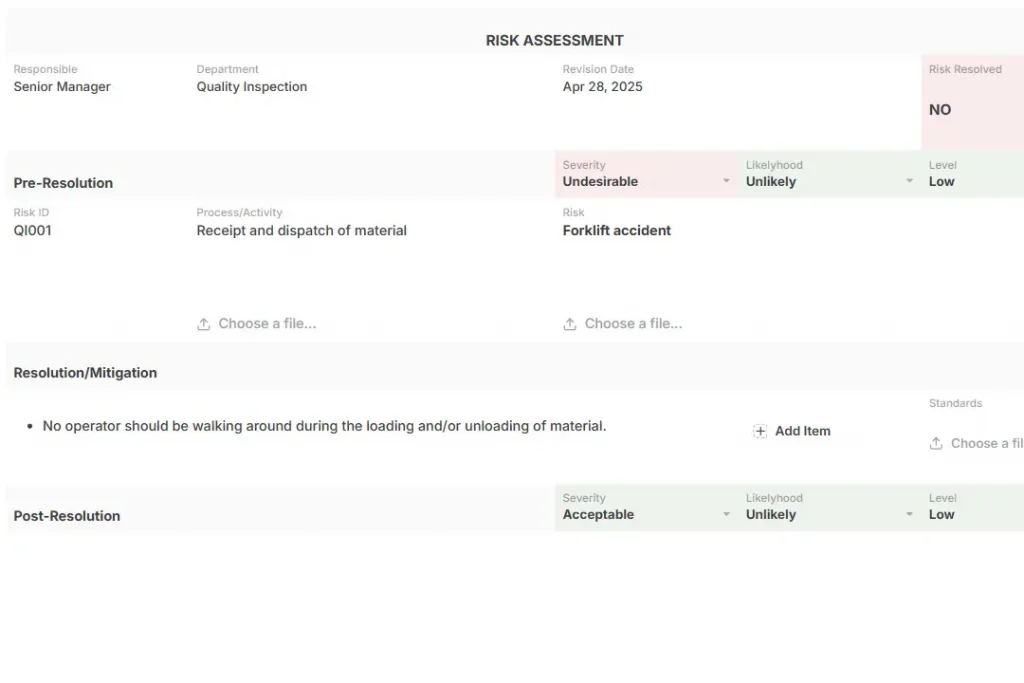
Risk management is a foundational component of third-party oversight. The objective is to identify exposure early, classify it accurately, and reassess it as relationships evolve.
This includes early identification, clear tiering, and ongoing evaluation based on contractual scope, performance, and regulatory context. Key data you should store:
- Risk Severity: Acceptable, Tolerable, Undesirable, Intolerable.
- Risk Likelihood: Likely, Unlikely.
- Risk Level: Low, Medium, High.
Within AnyDB, teams can define custom risk score fields directly on supplier records using formulas or weighted criteria. Risk assessments can also be tracked as connected objects, creating a historical view of risk changes and allowing early detection of deteriorating profiles.
Vendor Onboarding and Vetting
A structured onboarding process ensures new partners meet legal, tax, and internal requirements before entering operations. When onboarding depends on email threads and spreadsheets, gaps are unavoidable.
Core activities include due diligence, sanctions screening, and legal, tax, and banking validation. AnyDB supports this through integrated forms generated from an onboarding template.
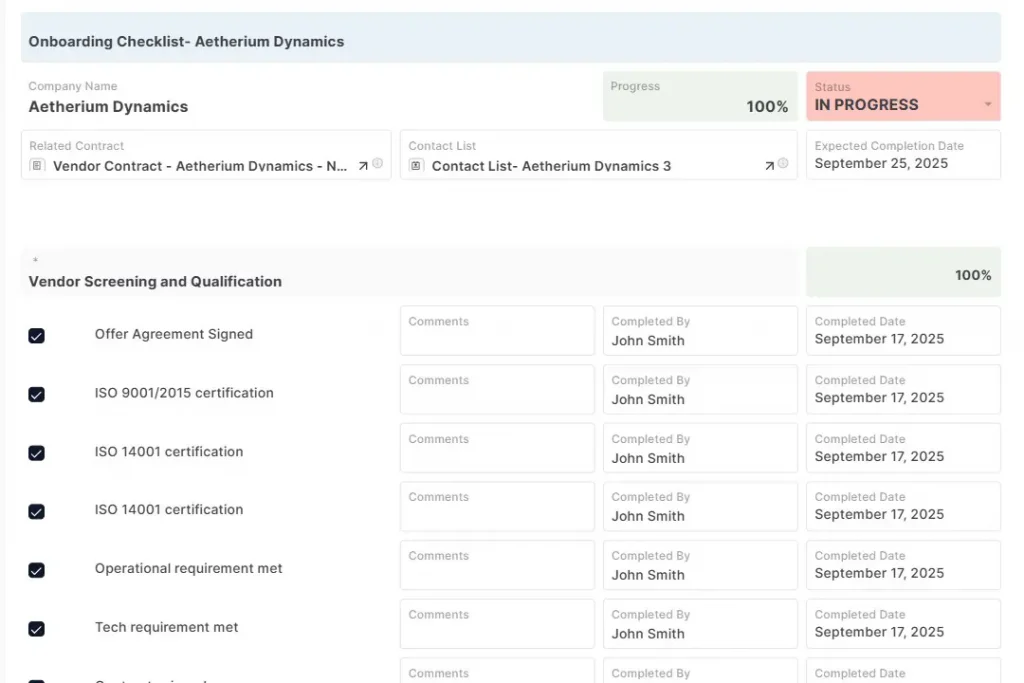
Suppliers submit structured data, such as tax ID, legal name, and banking details through a public form. Submissions automatically create standardized records, with mandatory fields preventing critical checks from being skipped.
See how to create and share forms in AnyDB:
Continuous Monitoring and Performance Evaluation
Oversight does not end after initial approval. Contracts expire, certificates lapse, and performance levels change. Without ongoing monitoring, exposure accumulates quietly and often surfaces only after impact occurs.
This area focuses on real-time status tracking, contract adherence, and early escalation of deviations. The emphasis shifts from reaction to prevention.
AnyDB enables this through follow-up dates embedded directly in records, such as Next Audit or Insurance Expiration. Automated alerts notify owners as deadlines approach, enabling timely action and reducing failures caused by oversight.
A centralized Vendor Dashboard consolidates status, risk, and open items into a single operational view:
Documentation and Audit Readiness
Audits demand speed, accuracy, and context. When contracts, licenses, and certificates are spread across folders and tools, response effort increases dramatically.
Here, documentation serves more than archival purposes. Contracts, certifications, insurance policies, and review records must remain accessible and clearly linked to the correct entity.
AnyDB attaches documents directly to supplier records, creating a unified, contextual view. Associating an insurance certificate or contract amendment with the relevant record establishes a clear audit trail and a reliable single source of truth.
What is a vendor compliance manager job description?
The vendor compliance manager is responsible for designing, operating, and maintaining the organization’s third-party compliance framework. The role ensures external partners meet regulatory, contractual, and internal expectations throughout the relationship.
Key responsibilities include defining policies, overseeing onboarding and ongoing reviews, and managing exceptions before they escalate into material risk.
This position also acts as a bridge between procurement, legal, finance, risk, and operations, coordinating audits and ensuring compliance information remains accurate, connected, and current.
Vendor Compliance Management Strategies
Effective compliance programs operate in daily workflows, not just in documentation. This requires combining clear rules, executable processes, and continuous visibility across all suppliers.
Implement Vendor Compliance Policies
Start with clear, enforceable policies that define mandatory requirements, documentation standards, and review intervals. Policies must be operational, not theoretical, to avoid inconsistent interpretation.
Create Vendor Compliance Programs
A program translates policies into execution. It defines ownership, approval criteria, and monitoring routines across the lifecycle.
Conduct Vendor Risk Assessments
Risk-based oversight allows organizations to focus effort where impact is highest. Structured, recurring assessments support prioritization and faster response when risk profiles change.
Implement a Vendor Portal
Vendor portals streamline data collection and updates through a single interaction point. This reduces email dependency and improves data quality. Learn more in this video:
Manage Vendor Non-Compliance
Exceptions must be visible across the organization. Status labels such as Active, Probation, or Blacklisted allow procurement and operations to act consistently. Because records are connected, changing a supplier’s status in AnyDB can automatically flag related purchase orders or projects, preventing new engagement until remediation occurs.
Checklist for Vendor Termination
Relationship termination requires the same rigor as onboarding. A structured vendor offboarding checklist ensures contracts are closed, access is revoked, and obligations are resolved without residual exposure.
Vendor Compliance and Performance Template
Most companies separate vendor compliance from vendor performance: legal documents live in one folder, KPIs live in a spreadsheet, and audit notes sit in someone’s inbox.
The Vendor Compliance and Performance template in AnyDB brings everything into a single, structured vendor record:
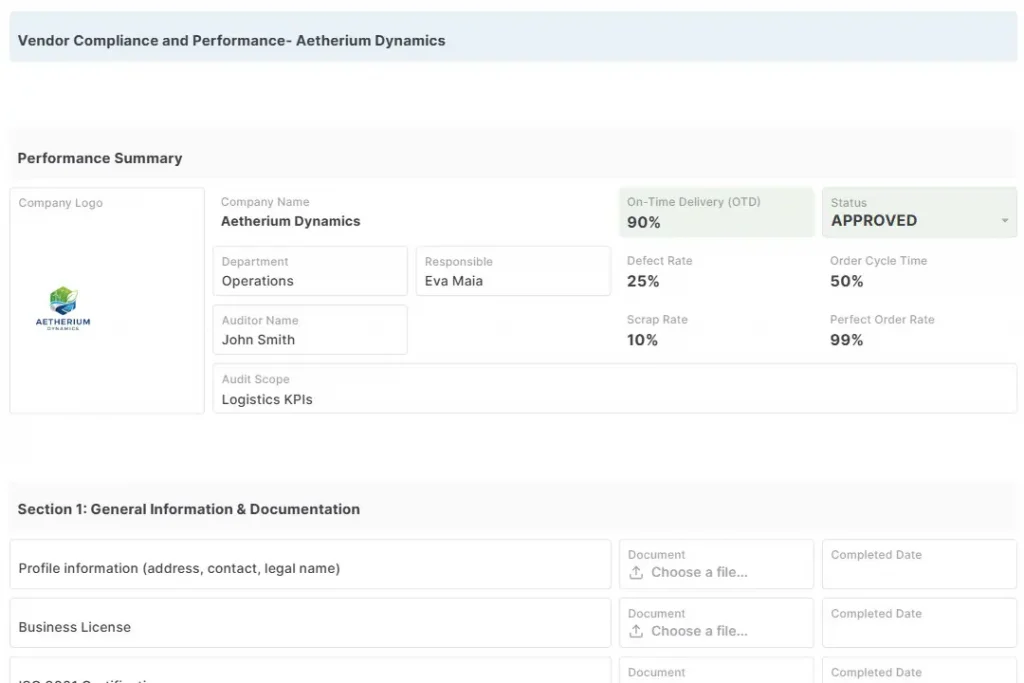
At the top, live performance badges instantly show the supplier’s status (Approved, Conditional, Not Approved) and operational metrics like On-Time Delivery (OTD). A procurement manager can immediately see whether a supplier delivering components for a production line is reliable, or already trending below threshold.
The General Information & Documentation section works as a real compliance gate. Before a logistics partner is activated, the system confirms business licenses, ISO certifications, and insurance coverage (General Liability, Cyber Liability, Transport, etc.) are on file and verified. No document, no approval.
In Quality & Performance, KPIs like Defect Rate, Scrap Rate, Rework Rate, and Order Cycle Time are logged for defined periods, with supporting reports uploaded directly to the record. A manufacturing team reviewing quarterly supplier performance can see time-series data instead of isolated snapshots.
The Audit Findings section turns each review into a documented decision. Auditor name, scope, comments, and Conditions for Approval are recorded clearly, creating a defensible audit trail.
Common Challenges in Vendor Compliance Management
Even organizations with clear policies struggle with execution when compliance data, ownership, and deadlines are spread across teams and tools. The challenge is operational, not conceptual.
The most common issues include:
- Fragmented data across spreadsheets, emails, and disconnected systems;
- Manual follow-ups that depend on individual reminders;
- Missed renewals of contracts, licenses, and insurance;
- Poor visibility into who is compliant and who represents risk;
- Audit stress caused by last-minute evidence collection;
- Spreadsheet dependency that limits traceability at scale.
These gaps create a reactive model where compliance absorbs effort without building confidence. Structured platforms like AnyDB address this by centralizing data and automating follow-ups.
How AnyDB Supports Vendor Compliance Management
AnyDB centralizes supplier records, compliance fields, documents, contracts, and history into a single structured object, providing traceability across the full supplier lifecycle.
The platform supports structured compliance tracking, status-driven workflows, renewal and expiration alerts, and role-based access.
Its object-based model allows teams to adapt quickly as requirements change. New regulations, standards like GDPR and SOC 2, or internal policies can be reflected by adding fields or document types in minutes, without relying on rigid ERP modules.
The result is a flexible platform built to operate and adapt compliance programs, not simply store documents.
Frequently Asked Questions About Vendor Compliance Management
Still have questions? Explore the most common ones below.
What does a vendor compliance manager do?
A vendor compliance manager ensures vendors meet regulatory, contractual, and internal policy requirements by overseeing onboarding, monitoring, audits, and issue resolution.
What standards apply to vendor compliance?
Common standards include ISO 27001, SOC 2, GDPR, HIPAA, and PCI DSS, along with internal policies and contractual compliance requirements.
How do companies monitor vendor compliance?
Companies monitor vendor compliance by tracking documents, certifications, audits, and performance through structured records, reviews, and automated alerts.
Do I need vendor compliance management software?
Vendor compliance management software is needed when spreadsheets and manual tracking no longer provide visibility, accuracy, or audit readiness at scale.

One Place for All Your Business Data and Operations
No more scattered spreadsheets or rigid, disconnected tools.
AnyDB is a modern, customizable platform for managing business records and operations across teams, clients, and partners.
Learn More


Phone: (512)-761-7979
© 2024 Humanly Inc. All rights reserved.
What is AnyDB?
AnyDB is a unified, customizable data store designed to streamline and empower your entire organization. Effortlessly store, organize, and share custom business data to drive both internal and external operations across teams. Think of it as spreadsheets on steroids.Perfect for Sales, Marketing, Operations, HR, and beyond. Discover AnyDB