
Published on February 12, 2026


Vendor compliance is one of the first bottlenecks that emerges when a company starts scaling operations with multiple vendors. What once fit into a simple spreadsheet quickly turns into a web of expired certificates, documents scattered across folders, endless email threads, and invisible risks.
For growing companies, vendor compliance must be treated as a continuous operational discipline. And this is exactly where many operations break down: not due to a lack of rules, but due to a lack of structure.
In this article, you will learn what vendor compliance is, why it becomes more complex as companies grow, and how to structure this process effectively.
What Is Vendor Compliance?
Vendor compliance refers to the set of legal, regulatory, operational, and contractual requirements that vendors must meet in order to provide services or deliver products to a company.
Its purpose is to ensure that third parties remain compliant with required documentation, certifications, insurance coverage, internal policies, and external regulations, both before and throughout the commercial relationship.
It is important, first, to distinguish concepts that are often confused:
- Internal compliance relates to the company’s own internal rules, controls, and governance.
- Vendor compliance focuses on the compliance of third parties that directly impact operations, reputation, and regulatory exposure.
Another critical point: vendor compliance is not a one-time event. Certificates expire, insurance policies require renewal, regulations change, and audits take place. As a result, a vendor that is fully compliant today can become an operational risk tomorrow if monitoring is not continuous.
This is why mature organizations treat vendor compliance as a living process, integrated across the entire vendor lifecycle.
Why Vendor Compliance Matters for Growing Companies
As a company grows, its reliance on vendors increases across contracts, regions, and regulatory requirements. At the same time, the margin for error shrinks. This combination leads to several potential risks:
- Regulatory exposure: fines, penalties, and operational disruptions caused by non-compliance.
- Operational risk: non-compliant vendors can delay projects, compromise deliveries, or trigger incidents.
- Poor audit readiness: when data is fragmented, responding to audits becomes a manual and reactive effort.
- Reputational damage: a single non-compliant vendor can directly impact the company’s public image.
- Dependency risk: without clear visibility, companies continue working with partners that no longer meet minimum compliance standards.
Spreadsheets, shared folders, and isolated vendor portals were never designed to handle dozens or hundreds of vendors, each with different rules and deadlines. Scaling operations without structuring vendor compliance is, ultimately, accepting silent and compounding risks.
Common Vendor Compliance Requirements
While requirements vary by industry and region, certain elements appear consistently in U.S.-based operations and in companies with more complex supply chains. Common examples include:
- Insurance certificates: Active insurance coverage such as General Liability, Workers’ Compensation, and Auto Liability, with defined minimum coverage limits.
- Safety and quality certifications: ISO, OSHA, and other technical or quality certifications required to perform services or deliver products.
- Regulatory documents: Business licenses, tax registrations, and applicable state or federal authorizations.
- Security and data protection policies: SOC 2 reports, information security policies, confidentiality agreements, and data protection requirements.
- Ethical and legal attestations: Legal compliance statements, codes of conduct, anti-corruption policies, and labor law compliance declarations.
One of the biggest challenges, however, is ensuring that all required data and mandatory documents are collected correctly from the very beginning. This is where many companies hit the limitations of rigid ERPs or generic systems: the available fields simply do not reflect the reality of the operation.
As a result, information becomes incomplete or inconsistent.
How AnyDB Handles Those Requirements
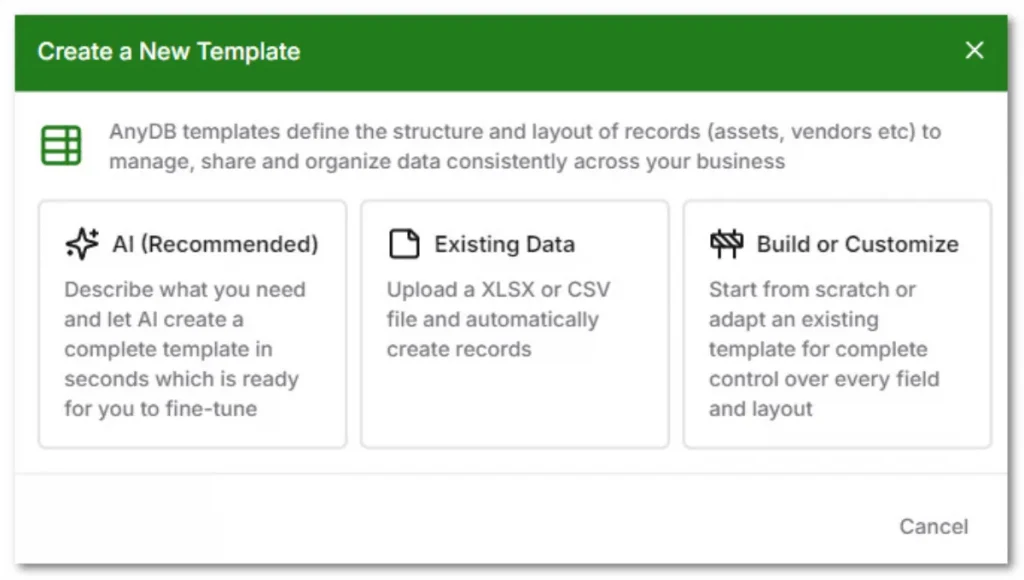
This is exactly where AnyDB helps. You can create a Vendor Template fully aligned with your regulatory and operational requirements. In practice, this allows you to:
- Create specific fields such as Tax ID, Insurance Limit, SOC 2 Status, and ISO Certification Number.
- Require mandatory file uploads for each vendor, including Certificates of Insurance (COI), technical certifications, and signed policies.
At AnyDB, the template adapts to your business, not the other way around. You can create it in three ways: using AI from a prompt, importing existing data (XLSX or CSV), or duplicating a complete template. This ensures that no vendor can move forward in the process without delivering exactly what your operation requires.
You don’t have to design the system alone. Our team will build your first operational workflow with you — at no cost — ensuring your vendor compliance structure is set up correctly from day one.
Share your workflow requirements or schedule a short call, and we’ll translate your process into a working system without adding complexity to your team.
Vendor Compliance Checklist
Checklists only work when they are connected to a system that enforces execution, traceability, and real operational controls. Below is a practical checklist used by companies that treat vendor compliance as a core operational discipline.
1. Required Documents
- Active insurance certificates (COI)
- Technical or safety certifications
- Applicable regulatory licenses
- Information security and data protection policies
- NDAs and legal or ethical declarations
2. Verification Steps
- Validation of document authenticity
- Confirmation of required minimum coverage limits
- Review of expiration dates
- Assessment of contract or region specific requirements
3. Approval Status
- Under review
- Approved
- Rejected
- Pending update
4. Expiration Tracking
- Clearly visible expiration dates
- Automated alerts prior to expiration
- Operational blocking when documents expire
5. Review Cadence
- Periodic reviews (monthly, quarterly, or annually)
- Revalidation during contract renewals
- Internal or external audits
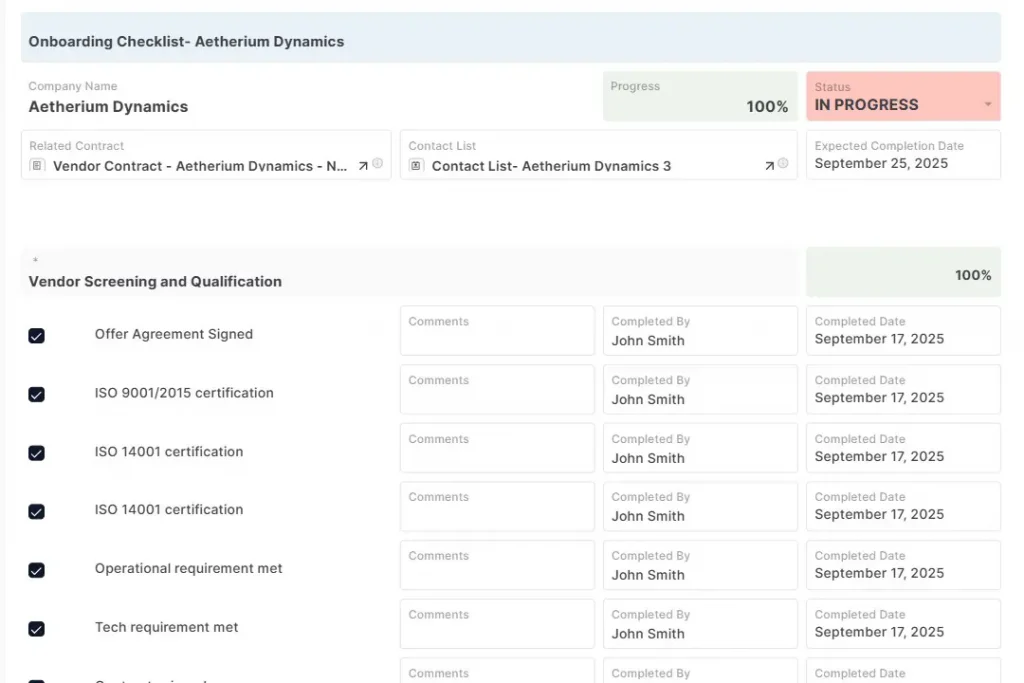
In AnyDB, the checklist is not a standalone PDF or an Excel spreadsheet. It is a connected object tied directly to the vendor:
- You create an Onboarding Checklist as its own object;
- This checklist is linked directly to the Vendor Record;
- The checklist can also be associated with a specific contract;
- A vendor cannot be marked as Active until every checklist item is completed.
This turns vendor compliance into an executable process, not a subjective one. Use this template to see how it works in practice:
Vendor Compliance Software and Portals
Many companies begin their vendor compliance journey using vendor portals or dedicated login-based systems. Tools such as Compliance Depot are common examples of this model. They offer clear advantages, but also come with important limitations:
| Strengths | What to consider |
| Industry standardization | Rigid structures that do not reflect real operational workflows |
| Broad acceptance in certain markets | Siloed data with no connection to contracts, projects, or assets |
| Processes already familiar to auditors | Limited integration with internal systems |
| Ease of initial adoption | Rigid experience for both vendors and internal teams |
As a result, the solution often becomes a portal running in parallel with spreadsheets and internal systems, which recreates the exact problem these tools were meant to solve.
With AnyDB, the approach is different. Instead of forcing all vendors into a separate external portal, you can offer Secure Guest Access directly within their records. This allows you to:
- Give each vendor access only to their own profile;
- Enable direct uploads of renewed certificates;
- Allow document updates without email back-and-forth.
Also, with granular permissions, vendors can:
- Edit their own documents;
- Not see internal notes;
- Not access data from other vendors.
Another important differentiator is unlimited guest access, with no additional cost per vendor. This reduces costs, improves security, and keeps all data within the same operational system. See how it works in the explanatory video below:
How AnyDB Supports Vendor Compliance Management
Do not think of AnyDB as a document repository. The platform functions as a flexible system, designed to adapt to how your business actually operates. In practical terms, this means:
- Centralized vendor records: Each vendor has a single record containing data, documents, and full history.
- Structured compliance fields: Dedicated fields for status, certifications, insurance limits, and regulatory requirements.
- Document storage tied to vendors: Files are not loose in folders; they belong to the vendor and the correct operational context.
- Expiration and status tracking: Visibility into dates, automated alerts, and operational blocking when items expire.
- Role-based access: Each person sees only what is relevant to their responsibilities.
- Audit-ready history: A complete log of approvals, changes, and documents, ready for audits at any time.
- Vendor compliance portals with unlimited guest access: Share secure, structured views with vendors so they can upload certifications, update documentation, or respond to requests directly, without additional seat costs.
All of this without forcing your operation into a rigid portal model.
Vendor compliance is multidimensional, and vendors rarely exist in isolation. That is why, in AnyDB, every entity is treated as a real-world object, connected to others. A Vendor can be linked to:
- Products that require specific safety or quality certifications;
- Projects with defined timelines and risk exposure;
- Regions with distinct tax or regulatory requirements.
This means you can attach a Safety Certificate object to a vendor and link that vendor to an active project. If the certificate expires, the risk immediately becomes visible at the project level. The impact appears exactly where it matters. See this advantage in action in the video below:
Frequently Asked Questions About Vendor Compliance
Get your vendor compliance questions answered with the FAQs below:
What documents are required for vendor compliance?
It depends on the industry and region, but commonly includes insurance certificates, technical certifications, regulatory licenses, security policies, and legal or ethical declarations.
How do companies track vendor compliance?
Mature organizations rely on structured systems to track status, documents, expiration dates, and approval history, avoiding spreadsheets and scattered folders.
How do vendor compliance audits work?
Auditors verify whether active vendors met all required criteria during the audited period. Having centralized, traceable data dramatically reduces audit effort.
Do I need vendor compliance software?
If your company manages multiple vendors, contracts, and regulatory requirements, dedicated vendor compliance software stops being optional and becomes an operational necessity.

The End-to-End Operations System that Finally Fits Your Reality.
No more scattered spreadsheets or rigid, disconnected tools.
AnyDB is a modern, customizable platform for managing business records and operations across teams, clients, and partners.
Learn More


Phone: (512)-761-7979
© 2024 Humanly Inc. All rights reserved.
What is AnyDB?
AnyDB is a unified, customizable data store designed to streamline and empower your entire organization. Effortlessly store, organize, and share custom business data to drive both internal and external operations across teams. Think of it as spreadsheets on steroids.Perfect for Sales, Marketing, Operations, HR, and beyond. Discover AnyDB