
Published on December 22, 2025


A compliance report exists to show, with clarity and evidence, whether operations follow laws, regulations, and internal policies. In regulated industries, that only works when the underlying data is consistent, traceable, and audit-ready.
Still, the reality is usually the opposite: scattered spreadsheets, conflicting versions, missing context, and a constant struggle to demonstrate due diligence.
This fragmentation creates avoidable risk and slows down the entire process. That’s why more teams are adopting structured formats that organize findings, evidence, and corrective actions in a consistent way.
With a solid template guiding the workflow, information becomes clearer, rework drops, and both internal and external audits gain predictability. Want to dig deeper? Keep reading.
What Is a Compliance Report?
A compliance report is a structured document that outlines how the organization aligns with regulatory requirements, internal standards, and industry frameworks. It consolidates what was assessed, which rules apply, and how the company performed against each one.
Unlike informal notes or ad-hoc spreadsheets, it’s a formal piece of compliance documentation built around a logical structure. It centralizes findings, evidence, risk points, and recommended corrective actions.
That structure creates traceability, supports regulatory reporting, and offers a reliable snapshot for auditors, regulators, and internal leaders.
Why Compliance Reports Matter
These reports clarify the purpose of compliance: demonstrating, with verifiable data, whether the operation meets legal and internal expectations. They bring transparency to strengths, gaps, and areas that require attention, which is critical in any compliance reporting workflow.
They also reduce operational and regulatory risk. When information is organized and properly documented, teams catch issues earlier, avoid penalties, and make decisions based on evidence instead of assumptions.
And the impact is significant. Regulators, partners, and customers gain confidence, while internal teams benefit from more discipline, cleaner controls, and fewer interpretation gaps.
Compliance Reports vs. Audit Reports
Compliance reports and audit reports often get lumped together, but they serve different purposes. In the compliance report vs audit comparison, the distinction is straightforward:
- A compliance report documents adherence to laws, internal policies, and regulatory requirements.
- An audit report evaluates whether controls, processes, and risk-management practices are actually working.
So, one is driven by obligations; the other, by independent verification of how the operation performs.
Even so, they depend on each other. Audit findings often become evidence, deviations, or corrective actions that must be reflected in compliance reporting.
When both work in sync, the organization maintains a continuous cycle of oversight and improvement.
Key Components of a Compliance Report
A compliance report must follow a clear structure to be useful, auditable, and comparable over time. Core components include:
- Executive summary with context and key risks
- Compliance checklist covering regulatory requirements, internal policies, and frameworks
- Assessment findings
- Evidence supporting each conclusion
- Corrective actions and follow-up items
The quality of the report depends on the consistency of these elements. That’s why AnyDB’s compliance templates rely on clear headings, named fields, and stable layouts that standardize reporting.
With this structure, teams minimize variation, reduce rework, and maintain audit-ready documents for inspections, reviews, or regulatory submissions.
Types of Compliance Reports (with examples)
Compliance reports vary widely depending on the industry and operational risk involved. Each type of compliance report requires specific evidence, documentation, and validation criteria. Because of that, there’s no “one-size-fits-all” model, only formats aligned with distinct regulatory expectations:
- Financial Compliance: SOX, AML, PCI DSS
- Healthcare Compliance: HIPAA
- Data & Cybersecurity: GDPR, NIST, ISO, SOC 2
- HR Compliance: labor law, benefits, payroll reviews
- Corporate Governance & ESG: sustainability disclosures, internal governance reviews
These categories show how the scope ranges from financial controls to data privacy, from information security to employment requirements. That’s where structured templates become especially useful.
A practical compliance report example is the Vendor Compliance and Performance template, which consolidates documentation checks, operational KPIs, and audit findings into a single, ongoing record.
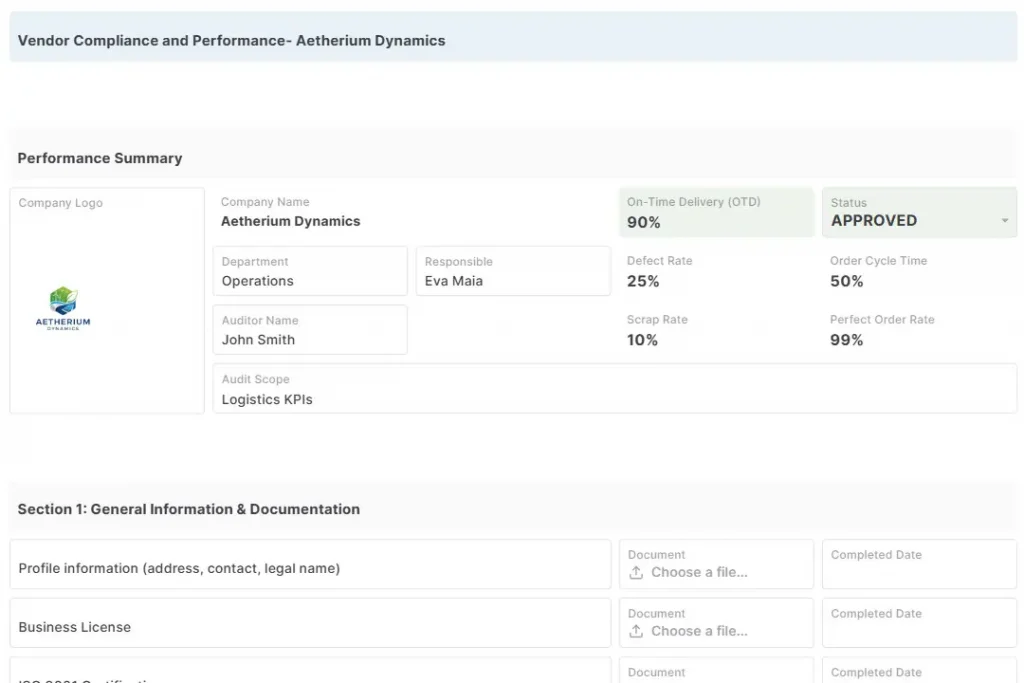
This model illustrates how compliance reports become far more valuable when they operate as structured evidence hubs rather than isolated files. The result is stronger audit readiness, clearer risk visibility, and more consistent review cycles.
How to Create a Compliance Report (step-by-step)
Creating a compliance report requires a methodical approach. It’s not about filling out a document, it’s about converting regulatory requirements into traceable evidence.
A practical workflow includes:
- Define the regulatory scope
Laws, internal policies, and applicable frameworks.
- Collect evidence
Documents, records, metrics, logs, supporting files.
- Conduct internal assessments
Control testing, interviews, risk analysis.
- Document findings
Structure them according to the compliance report format.
- Add corrective actions
Complete the view with owners, deadlines, and status.
- Review
Approve and distribute to ensure audit readiness.
Inside AnyDB, each step becomes more predictable. Compliance report templates reduce variation, databases replace scattered spreadsheets, and relationships link findings, documents, and corrective actions in a single environment.
The result is a continuous, auditable process that’s harder to break and far easier to maintain.
Why Compliance Reporting Fails in Spreadsheets
Manual processes introduce risk, and spreadsheets simply weren’t designed for regulatory workflows. The first problem is the lack of version control and the absence of any audit trail, which undermines the ability to demonstrate due diligence.
There’s also an operational bottleneck. Spreadsheets can’t link findings, evidence, and corrective actions in a meaningful way, forcing teams to jump between tabs, folders, and emails to rebuild context.
Without automation, there’s no scoring, risk classification, or real-time compliance status.
Together, these gaps create errors, rework, and regulatory blind spots, exactly what pushes organizations toward structured, data-driven tools like AnyDB.
Managing Compliance Reports in AnyDB
With AnyDB, managing compliance reports becomes a structured process instead of guesswork. The platform organizes everything into structured databases with predictable templates, standardized fields, and embedded calculations. That eliminates inconsistencies and creates a shared language across teams.
Because the databases connect Internal Audit, Vendor Performance, and Non-Conformance Reports, the compliance report stops being an isolated document and becomes part of a complete compliance cycle.
Automation handles scoring and status updates without parallel spreadsheets, while centralized evidence creates a clean, traceable audit trail. The video below shows this workflow in practice.
The goal is simple: unify Compliance, Quality, and Governance in a single environment, without unnecessary layers or costly upgrades to reach operational maturity.
Want to see how structured reporting actually works in practice?
Explore AnyDB’s templates and test how they simplify documentation, evidence tracking, and audit readiness.
Frequently Asked Questions About Compliance Report
Still have questions? Here are the ones people ask the most.
What is the purpose of compliance?
Compliance exists to prove that an organization actually follows the rules it claims to follow. It protects the business from regulatory, financial, and operational exposure by turning obligations into traceable, verifiable practices.
What is a compliance sample?
A compliance sample is a reference document or template that shows how findings, evidence, and requirements should be organized. It’s a baseline for structuring reports without reinventing the wheel every time.
What is an example of compliance?
A practical example is documenting how your company meets GDPR requirements as policies updated, data-handling logs stored, access controls tested, and evidence attached.

One Place for All Your Business Data and Operations
No more scattered spreadsheets or rigid, disconnected tools.
AnyDB is a modern, customizable platform for managing business records and operations across teams, clients, and partners.
Learn More


Phone: (512)-761-7979
© 2024 Humanly Inc. All rights reserved.
What is AnyDB?
AnyDB is a unified, customizable data store designed to streamline and empower your entire organization. Effortlessly store, organize, and share custom business data to drive both internal and external operations across teams. Think of it as spreadsheets on steroids.Perfect for Sales, Marketing, Operations, HR, and beyond. Discover AnyDB